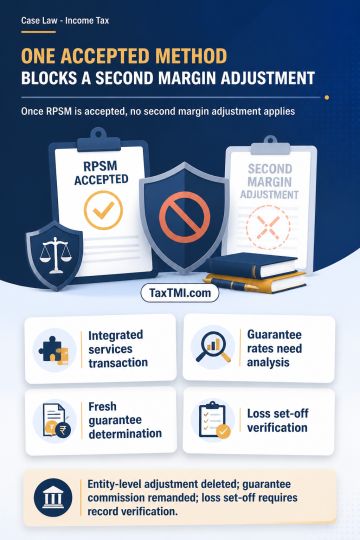
Form 26AS evidence requires successor-entity accounting verification after business transfer, while invoice-supported related-party advertising expend...
Money-laundering judgment timing requires awaiting the scheduled-offence decision despite continuation of the underlying trial where outcomes directly...
Accredited investor eligibility expands through securities-market exposure, while alternative investment fund disputes require prescribed resolution a...
Page of 4916
Press 'Enter' after typing page number.
41 to 60 of 98302 Results
❮
❯
❯❯
0 / 200
Expand Note
Add to Folder
No Folders have been created
+
Are you sure you want to delete "My most important" ?
Anticipatory bail principles were applied pari passu with...
Anticipatory Bail granted on conditions balancing presumption of innocence with investigative needs; passport surrender and regular attendance required.
Contents
Summary
Note
Bookmark
Share
✓ Copied successfully !
Print
Print Options
For full text, please login
Login to TaxTMI
Verification Pending
The Email Id has not been verified. Click on the link we have sent on
Anticipatory bail principles were applied pari passu with anticipatory provisions to protect liberty under Article 21, balancing it against investigation needs. The court found alleged customs undervaluation offences to be compoundable and triable by a Magistrate, with punishment up to seven years, but noted absence of criminal antecedents and lack of prima facie material beyond documentary records and a CHA statement while customs officers had cleared the entries. Custodial interrogation was not imperative; accordingly pre-arrest protection was granted subject to conditions (personal bond with surety, regular attendance before IO, passport surrender, identity/address proofs, non-interference with evidence and witness, and court permission to leave the country).
Anticipatory bail principles were applied pari passu with anticipatory provisions to protect liberty under Article 21, balancing it against investigation needs. The court found alleged customs undervaluation offences to be compoundable and triable by a Magistrate, with punishment up to seven years, but noted absence of criminal antecedents and lack of prima facie material beyond documentary records and a CHA statement while customs officers had cleared the entries. Custodial interrogation was not imperative; accordingly pre-arrest protection was granted subject to conditions (personal bond with surety, regular attendance before IO, passport surrender, identity/address proofs, non-interference with evidence and witness, and court permission to leave the country).
Note: It is a system-generated summary and is for quick reference only.
 TaxTMI
 TaxTMI

 of 4916