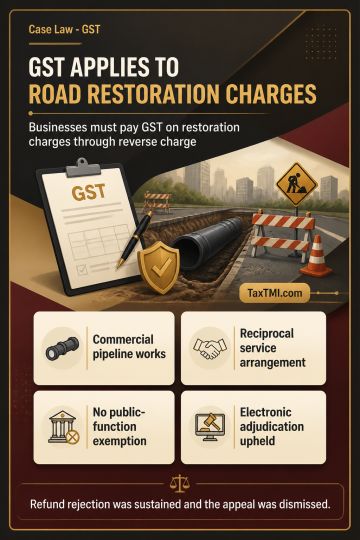
Request-driven road restoration attracts reverse-charge GST, not governmental-function treatment or compensatory-damages status for business recipient...
Road restoration charges for commercial pipeline works are taxable Government services, with reverse charge liability and no public-function exemption...
Model-wise import cap monitoring cannot justify withholding used multifunction machines where all-India tracking is absent and full security is furnis...
Condonation of delay in filing appeals against AAR orders is limited to a maximum extension of 30 days beyond the normal 30 day appeal period; the Appellate Authority (AAAR) lacks power to extend beyond that statutory window, so appeals filed beyond that limit must be rejected as time barred without consideration of merits. Rule permitting manual filing where electronic filing is prescribed does not excuse delay caused by non uploading of an order on the portal. The note also records the classificatory issue that transactions in immovable property may be outside Schedule III but treated as a service under Schedule II clause 5(e), though merits were not reached due to time bar.
Condonation of delay in filing appeals against AAR orders is limited to a maximum extension of 30 days beyond the normal 30 day appeal period; the Appellate Authority (AAAR) lacks power to extend beyond that statutory window, so appeals filed beyond that limit must be rejected as time barred without consideration of merits. Rule permitting manual filing where electronic filing is prescribed does not excuse delay caused by non uploading of an order on the portal. The note also records the classificatory issue that transactions in immovable property may be outside Schedule III but treated as a service under Schedule II clause 5(e), though merits were not reached due to time bar.
Note: It is a system-generated summary and is for quick reference only.
 TaxTMI
  TaxTMI
 of 4918