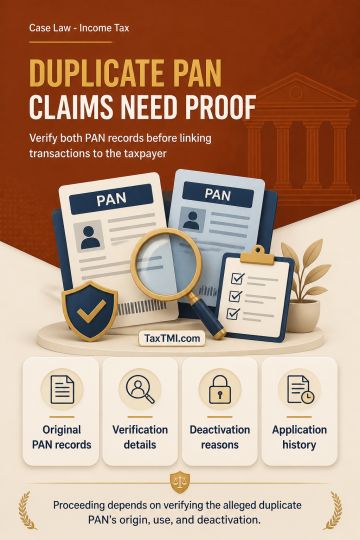
Duplicate PAN allocation requires record verification and deactivation reasons before assessment-related transactions can be attributed to an assessee...
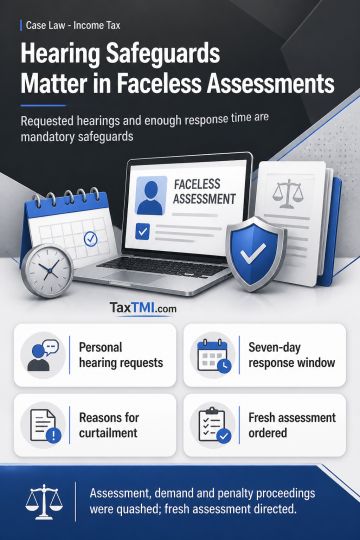
Faceless assessment safeguards require requested personal hearings and adequate final show-cause response time, failing which reassessment is required...
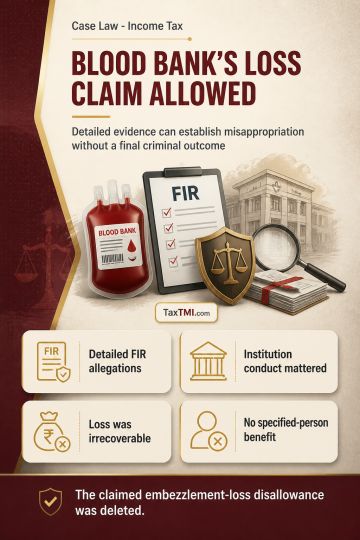
Embezzlement losses in charitable institutions remain allowable when misappropriation is established, irrecoverable, and not a specified-person benefi...
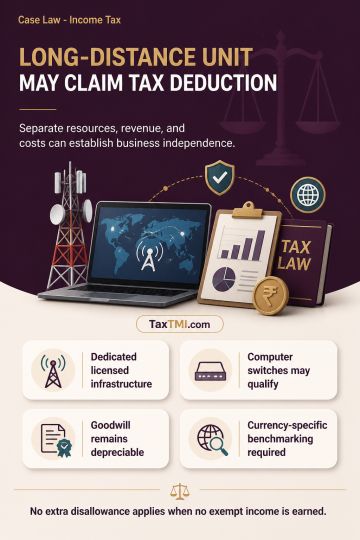
National long-distance undertaking status supports deduction where separately licensed infrastructure, resources, revenue, and expenditure establish c...
Agency reimbursement income follows contractual deposit-liability computation, while pending deposit collections do not constitute deemed-dividend loa...
Page of 4883
Press 'Enter' after typing page number.
41 to 60 of 97649 Results
❮
❯
❯❯
0 / 200
Expand Note
Add to Folder
No Folders have been created
+
Are you sure you want to delete "My most important" ?
Right to travel under Article 21 is affirmed as an essential aspect of dignity, but subject to proportionality of liberty-restricting conditions; courts must require a tangible and real flight-risk before imposing travel bars, and may exercise inherent jurisdiction to secure the ends of justice by imposing reasonable conditions rather than total prohibition. Applying those principles, the High Court found the petitioner's foreign business travel was not shown to be an actual flight risk and that denial would disproportionately harm family and commercial interests, and accordingly quashed the lower court order restricting travel.
Right to travel under Article 21 is affirmed as an essential aspect of dignity, but subject to proportionality of liberty-restricting conditions; courts must require a tangible and real flight-risk before imposing travel bars, and may exercise inherent jurisdiction to secure the ends of justice by imposing reasonable conditions rather than total prohibition. Applying those principles, the High Court found the petitioner's foreign business travel was not shown to be an actual flight risk and that denial would disproportionately harm family and commercial interests, and accordingly quashed the lower court order restricting travel.
Note: It is a system-generated summary and is for quick reference only.
 TaxTMI
  TaxTMI
 of 4883