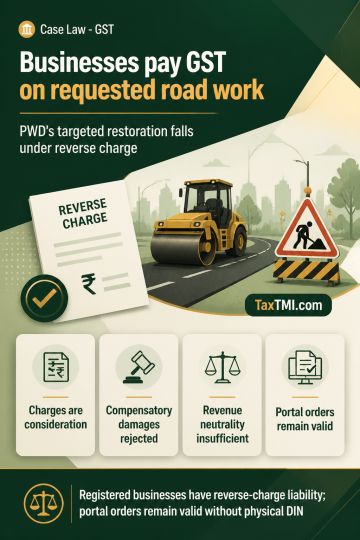
Request-driven road restoration attracts reverse-charge GST, not governmental-function treatment or compensatory-damages status for business recipient...
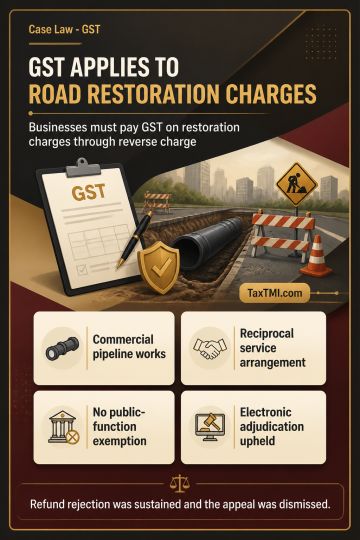
Road restoration charges for commercial pipeline works are taxable Government services, with reverse charge liability and no public-function exemption...
Model-wise import cap monitoring cannot justify withholding used multifunction machines where all-India tracking is absent and full security is furnis...
Failure to discharge obligations under Regulation 17(9) raised two legal issues: whether the penalty imposed was excessive and whether security deposit could be forfeited. The Tribunal held that Regulations 8(1) and 20 fix the statutory penalty ceiling at Rs.50,000, so imposing the maximum permitted cannot be treated as disproportionate; and the CBLR does not authorize forfeiture of the security deposit. Applying those statutory prescriptions, the impugned order imposing the maximum permissible penalty and not forfeiting the deposit was found valid, and the revenue's appeal was dismissed. - CESTAT
Failure to discharge obligations under Regulation 17(9) raised two legal issues: whether the penalty imposed was excessive and whether security deposit could be forfeited. The Tribunal held that Regulations 8(1) and 20 fix the statutory penalty ceiling at Rs.50,000, so imposing the maximum permitted cannot be treated as disproportionate; and the CBLR does not authorize forfeiture of the security deposit. Applying those statutory prescriptions, the impugned order imposing the maximum permissible penalty and not forfeiting the deposit was found valid, and the revenue's appeal was dismissed. - CESTAT
Note: It is a system-generated summary and is for quick reference only.
 TaxTMI
  TaxTMI
 of 4918