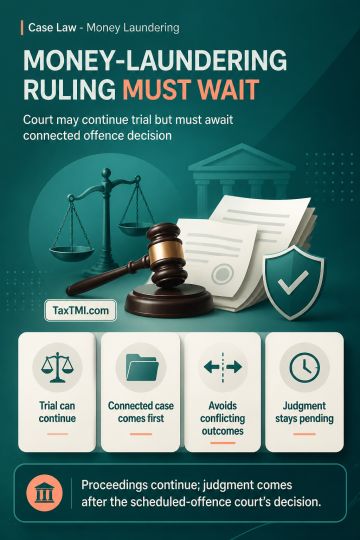
Money-laundering judgment timing requires awaiting the scheduled-offence decision despite continuation of the underlying trial where outcomes directly...
Accredited investor eligibility expands through securities-market exposure, while alternative investment fund disputes require prescribed resolution a...
Customs Assessment Portal centralises classification and valuation guidance to support consistent, transparent and informed compliance across stakehol...
The dominant issue was whether the service agreements between regulated lenders and fintech service providers constituted proceeds of scheduled offences and unlawful outsourcing of core banking functions. The tribunal found that the co-lending structure, disguised as "performance guarantees" and revenue-sharing (service fees/minimum commitments), yielded guaranteed returns to lenders without capital deployment, and effectively outsourced core lending activities (loan sanctioning, KYC compliance and borrower management) in breach of RBI master directions; misuse of borrower data facilitated offences under IPC and IT Act. Consequence: contractual arrangements were treated as tainted and the appeal was dismissed. - AT
The dominant issue was whether the service agreements between regulated lenders and fintech service providers constituted proceeds of scheduled offences and unlawful outsourcing of core banking functions. The tribunal found that the co-lending structure, disguised as "performance guarantees" and revenue-sharing (service fees/minimum commitments), yielded guaranteed returns to lenders without capital deployment, and effectively outsourced core lending activities (loan sanctioning, KYC compliance and borrower management) in breach of RBI master directions; misuse of borrower data facilitated offences under IPC and IT Act. Consequence: contractual arrangements were treated as tainted and the appeal was dismissed. - AT
Note: It is a system-generated summary and is for quick reference only.
 TaxTMI
  TaxTMI
 of 4920