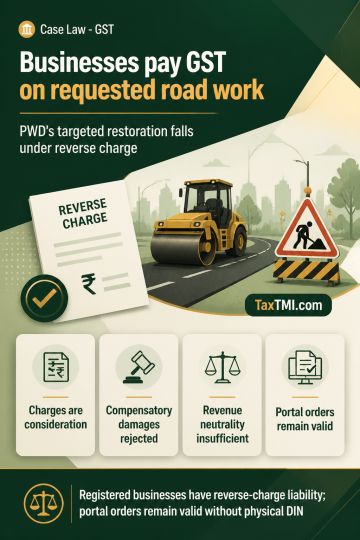
Request-driven road restoration attracts reverse-charge GST, not governmental-function treatment or compensatory-damages status for business recipient...
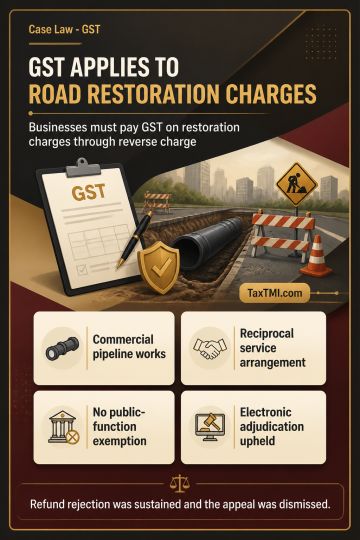
Road restoration charges for commercial pipeline works are taxable Government services, with reverse charge liability and no public-function exemption...
Model-wise import cap monitoring cannot justify withholding used multifunction machines where all-India tracking is absent and full security is furnis...
The dominant issue was whether a single mortgage deed securing repayment under multiple loan agreements attracted stamp duty under Section 4 (one transaction) or Section 5 (several distinct matters) of the Stamp Act. The court held Section 4 requires commonality of a single transaction, whereas Section 5 applies where distinct transactions are embodied in one instrument, requiring aggregate duty as if separate instruments existed. As the four loan agreements imposed separate obligations and constituted independent transactions, execution of one consolidated mortgage deed could not convert them into a common transaction; duty was correctly assessed separately for each loan, along with deficit consequences. The challenge to the revisional order was rejected and the petition was dismissed. - HC
The dominant issue was whether a single mortgage deed securing repayment under multiple loan agreements attracted stamp duty under Section 4 (one transaction) or Section 5 (several distinct matters) of the Stamp Act. The court held Section 4 requires commonality of a single transaction, whereas Section 5 applies where distinct transactions are embodied in one instrument, requiring aggregate duty as if separate instruments existed. As the four loan agreements imposed separate obligations and constituted independent transactions, execution of one consolidated mortgage deed could not convert them into a common transaction; duty was correctly assessed separately for each loan, along with deficit consequences. The challenge to the revisional order was rejected and the petition was dismissed. - HC
Note: It is a system-generated summary and is for quick reference only.
 TaxTMI
  TaxTMI
 of 4916