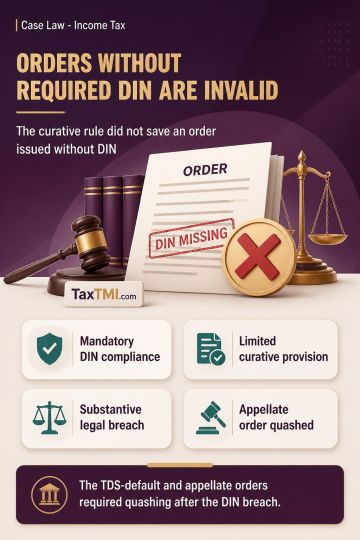
Document Identification Number compliance renders TDS-default orders invalid where mandatory DIN requirements are breached and curative provision does...
The dominant issue was whether imported "penetrating oil-60" was correctly classifiable as a lubricating preparation under CTH 3403 9900 or as adulterated diesel/petroleum product under CTH 2710 1990 with consequential valuation enhancement. The Department's reliance on hydrocarbon content exceeding 70% and presence of lighter hydrocarbons to treat the goods as "adulterated diesel" was rejected, since penetrating oils commonly contain 80-90% petroleum distillates plus additives, and the test reports did not establish equivalence with diesel or IS 1460 conformity. The Tribunal held that CTH 3403 can cover preparations where petroleum oils are the basic constituent, and the contrary interpretation was erroneous; the Department failed to discharge the burden to reclassify. Appeals allowed. - CESTAT
The dominant issue was whether imported "penetrating oil-60" was correctly classifiable as a lubricating preparation under CTH 3403 9900 or as adulterated diesel/petroleum product under CTH 2710 1990 with consequential valuation enhancement. The Department's reliance on hydrocarbon content exceeding 70% and presence of lighter hydrocarbons to treat the goods as "adulterated diesel" was rejected, since penetrating oils commonly contain 80-90% petroleum distillates plus additives, and the test reports did not establish equivalence with diesel or IS 1460 conformity. The Tribunal held that CTH 3403 can cover preparations where petroleum oils are the basic constituent, and the contrary interpretation was erroneous; the Department failed to discharge the burden to reclassify. Appeals allowed. - CESTAT
Note: It is a system-generated summary and is for quick reference only.
 TaxTMI
  TaxTMI
 of 4916