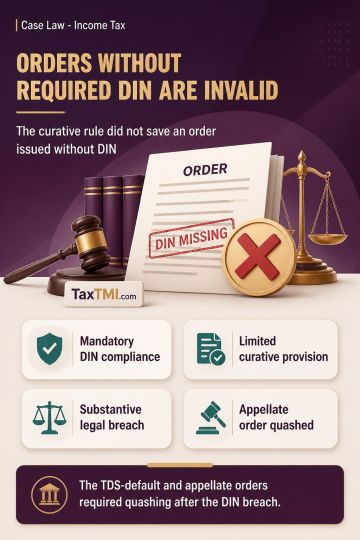
Document Identification Number compliance renders TDS-default orders invalid where mandatory DIN requirements are breached and curative provision does...
HC upheld the independence and mutual exclusivity of Sections 129 and 130 CGST, holding that confiscation under Section 130 can be invoked at the threshold if, upon interception and seizure during transit, the proper officer forms an opinion of intention to evade tax based on attendant circumstances. Section 129 applies where no such intention is found, and goods must then be dealt with strictly under that provision. Authorities cannot rely on Section 67(6) post-omission. All MOV-10 notices and MOV-11 orders are to be re-examined in light of these principles; where inconsistent, they must be withdrawn and goods released under Section 129. Petitions were disposed of accordingly.
HC upheld the independence and mutual exclusivity of Sections 129 and 130 CGST, holding that confiscation under Section 130 can be invoked at the threshold if, upon interception and seizure during transit, the proper officer forms an opinion of intention to evade tax based on attendant circumstances. Section 129 applies where no such intention is found, and goods must then be dealt with strictly under that provision. Authorities cannot rely on Section 67(6) post-omission. All MOV-10 notices and MOV-11 orders are to be re-examined in light of these principles; where inconsistent, they must be withdrawn and goods released under Section 129. Petitions were disposed of accordingly.
Note: It is a system-generated summary and is for quick reference only.
 TaxTMI
  TaxTMI
 of 4918