Form 26AS evidence requires successor-entity accounting verification after business transfer, while invoice-supported related-party advertising expend...
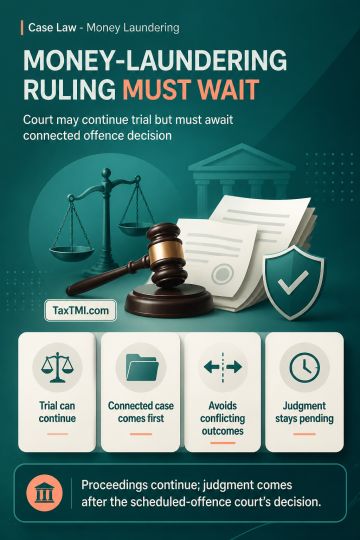
Money-laundering judgment timing requires awaiting the scheduled-offence decision despite continuation of the underlying trial where outcomes directly...
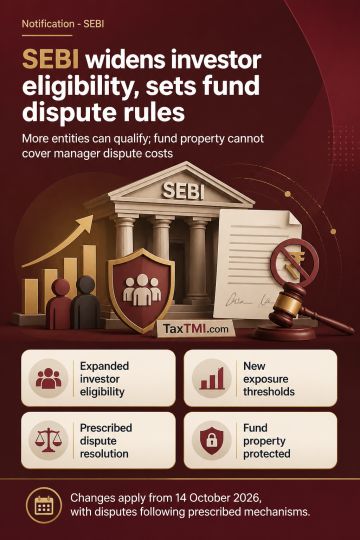
Accredited investor eligibility expands through securities-market exposure, while alternative investment fund disputes require prescribed resolution a...
Customs Assessment Portal centralises classification and valuation guidance to support consistent, transparent and informed compliance across stakehol...
Page of 4918
Press 'Enter' after typing page number.
101 to 120 of 98359 Results
❮
❯
❯❯
0 / 200
Expand Note
Add to Folder
No Folders have been created
+
Are you sure you want to delete "My most important" ?
HC upheld the independence and mutual exclusivity of Sections 129 and 130 CGST, holding that confiscation under Section 130 can be invoked at the threshold if, upon interception and seizure during transit, the proper officer forms an opinion of intention to evade tax based on attendant circumstances. Section 129 applies where no such intention is found, and goods must then be dealt with strictly under that provision. Authorities cannot rely on Section 67(6) post-omission. All MOV-10 notices and MOV-11 orders are to be re-examined in light of these principles; where inconsistent, they must be withdrawn and goods released under Section 129. Petitions were disposed of accordingly.
HC upheld the independence and mutual exclusivity of Sections 129 and 130 CGST, holding that confiscation under Section 130 can be invoked at the threshold if, upon interception and seizure during transit, the proper officer forms an opinion of intention to evade tax based on attendant circumstances. Section 129 applies where no such intention is found, and goods must then be dealt with strictly under that provision. Authorities cannot rely on Section 67(6) post-omission. All MOV-10 notices and MOV-11 orders are to be re-examined in light of these principles; where inconsistent, they must be withdrawn and goods released under Section 129. Petitions were disposed of accordingly.
Note: It is a system-generated summary and is for quick reference only.
 TaxTMI
  TaxTMI
 of 4918