Form 26AS evidence requires successor-entity accounting verification after business transfer, while invoice-supported related-party advertising expend...
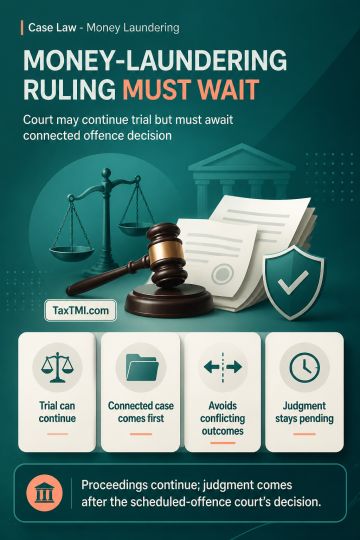
Money-laundering judgment timing requires awaiting the scheduled-offence decision despite continuation of the underlying trial where outcomes directly...
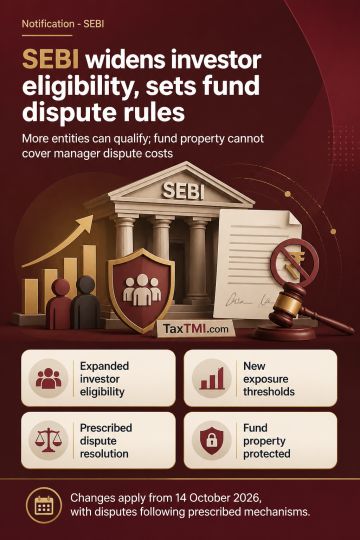
Accredited investor eligibility expands through securities-market exposure, while alternative investment fund disputes require prescribed resolution a...
Customs Assessment Portal centralises classification and valuation guidance to support consistent, transparent and informed compliance across stakehol...
Page of 4918
Press 'Enter' after typing page number.
101 to 120 of 98359 Results
❮
❯
❯❯
0 / 200
Expand Note
Add to Folder
No Folders have been created
+
Are you sure you want to delete "My most important" ?
CESTAT upheld the customs authority's rejection of the appellant's application for a Private Warehouse Licence under Section 58 of the Customs Act, 1962, interpreting Regulation 3(2)(c) of the PWLR to render ineligible any person on whom penalty under Section 114A has been imposed. The Tribunal held that the appellant's construction would make Regulation 3(2)(b) or 3(2)(c) redundant, contrary to settled principles of statutory interpretation requiring harmonious construction and effect to every provision. Accepting the Commissioner's reasoning that conviction-based disqualification falls under Regulation 3(2)(b) and penalty-based disqualification under 3(2)(c), CESTAT dismissed the appeal.
CESTAT upheld the customs authority's rejection of the appellant's application for a Private Warehouse Licence under Section 58 of the Customs Act, 1962, interpreting Regulation 3(2)(c) of the PWLR to render ineligible any person on whom penalty under Section 114A has been imposed. The Tribunal held that the appellant's construction would make Regulation 3(2)(b) or 3(2)(c) redundant, contrary to settled principles of statutory interpretation requiring harmonious construction and effect to every provision. Accepting the Commissioner's reasoning that conviction-based disqualification falls under Regulation 3(2)(b) and penalty-based disqualification under 3(2)(c), CESTAT dismissed the appeal.
Note: It is a system-generated summary and is for quick reference only.
 TaxTMI
  TaxTMI
 of 4918