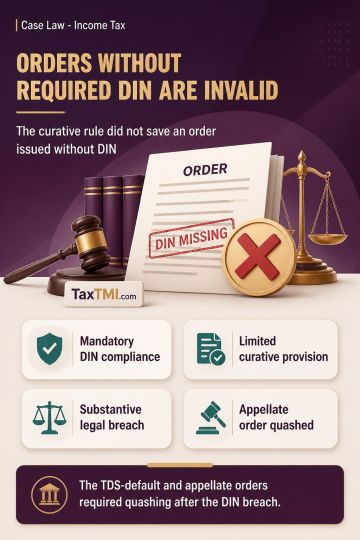
Document Identification Number compliance renders TDS-default orders invalid where mandatory DIN requirements are breached and curative provision does...
AAR held that concessional duty under Entry 527B of Notif. No. 50/2017-Cus is available for lithium-ion cells only when used in manufacture of battery or battery packs for electrically operated or hybrid motor vehicles, subject to strict compliance with the IGCR Rules, 2022. Cells used merely for replacement/repair under defects or warranty do not qualify as manufacture of a new product and are ineligible for exemption. Cells becoming obsolete and sold as scrap, or found defective and not issued to production, are treated as unutilized goods, attracting duty and interest under Rules 10 and 11 or requiring re-export or home clearance on payment of duty, with interest payable from date of import.
AAR held that concessional duty under Entry 527B of Notif. No. 50/2017-Cus is available for lithium-ion cells only when used in manufacture of battery or battery packs for electrically operated or hybrid motor vehicles, subject to strict compliance with the IGCR Rules, 2022. Cells used merely for replacement/repair under defects or warranty do not qualify as manufacture of a new product and are ineligible for exemption. Cells becoming obsolete and sold as scrap, or found defective and not issued to production, are treated as unutilized goods, attracting duty and interest under Rules 10 and 11 or requiring re-export or home clearance on payment of duty, with interest payable from date of import.
Note: It is a system-generated summary and is for quick reference only.
 TaxTMI
  TaxTMI
 of 4915