Electronic certificates of origin enable preferential tariffs under the India-New Zealand FTA when format, verification, and filing requirements are m...
Customs approval for liquid cargo exports extends designated jetty operations while existing boarding station and customs area limits remain unchanged...
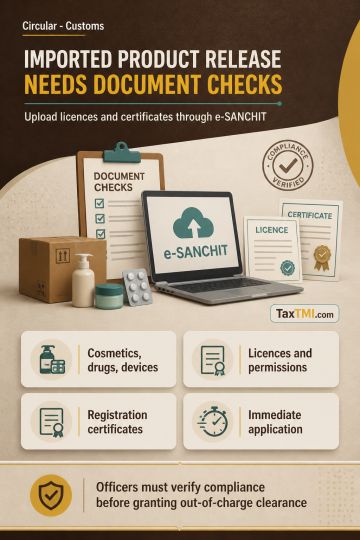
Mandatory compliance document verification now conditions out-of-charge clearance for imported cosmetics, drugs, and medical devices through PGA-facil...
Page of 4923
Press 'Enter' after typing page number.
41 to 60 of 98454 Results
❮
❯
❯❯
0 / 200
Expand Note
Add to Folder
No Folders have been created
+
Are you sure you want to delete "My most important" ?
SC allowed the appeal and set aside the impugned order referring the appellant to arbitration under Section 11(4). Applying the principles in Cox and Kings, SC held that the referral court's role is confined to a prima facie examination of the existence of an arbitration agreement and whether a non-signatory is a veritable party. On the facts, the appellant and respondent operated on "separate orbits" and no intention to bind the appellant to the contract between the other two entities was established, even prima facie. The respondent thus failed the prima facie test, and the dispute cannot be referred to arbitration against the appellant.
SC allowed the appeal and set aside the impugned order referring the appellant to arbitration under Section 11(4). Applying the principles in Cox and Kings, SC held that the referral court's role is confined to a prima facie examination of the existence of an arbitration agreement and whether a non-signatory is a veritable party. On the facts, the appellant and respondent operated on "separate orbits" and no intention to bind the appellant to the contract between the other two entities was established, even prima facie. The respondent thus failed the prima facie test, and the dispute cannot be referred to arbitration against the appellant.
Note: It is a system-generated summary and is for quick reference only.
 TaxTMI
 TaxTMI

 of 4923