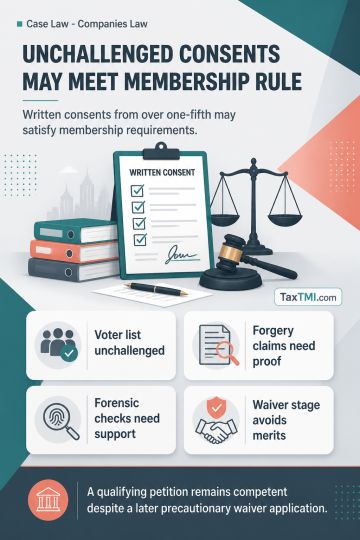
Membership-consent thresholds for oppression petitions are satisfied by unchallenged voter-list consents, while unsupported forgery claims require pro...
HC examined whether confiscation of funds in NRE/SB accounts used in contravention of FERA, 1973, is mandatory or discretionary under Section 63. HC held that, as Section 63 uses the term "may" and requires the authority to have "reason to believe" that the amounts are related to the proved breach, confiscation is discretionary and cannot be automatic or imposed as a matter of course. In the present case, the confiscation order was passed without independent application of mind. AT had rightly considered the nature of violations and set aside the routine confiscation. HC found no perversity in AT's approach and concluded that no substantial question of law arose. The appeal was dismissed.
HC examined whether confiscation of funds in NRE/SB accounts used in contravention of FERA, 1973, is mandatory or discretionary under Section 63. HC held that, as Section 63 uses the term "may" and requires the authority to have "reason to believe" that the amounts are related to the proved breach, confiscation is discretionary and cannot be automatic or imposed as a matter of course. In the present case, the confiscation order was passed without independent application of mind. AT had rightly considered the nature of violations and set aside the routine confiscation. HC found no perversity in AT's approach and concluded that no substantial question of law arose. The appeal was dismissed.
Note: It is a system-generated summary and is for quick reference only.
 TaxTMI
  TaxTMI
 of 4883