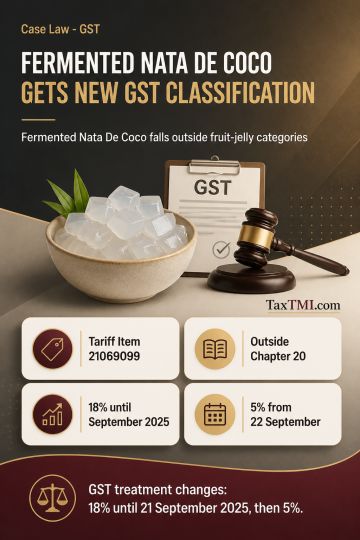
Residual food-preparation classification places fermented Nata De Coco outside fruit-jelly categories, changing its GST treatment across notified peri...
Settlement application eligibility requires a pending assessment when filed, preventing an extra prior-eligibility condition from blocking considerati...
Reassessment for unreturned property sales survives where transfer information, non-filing, and unsupported exemption claims establish a prima facie l...
Page of 4886
Press 'Enter' after typing page number.
521 to 540 of 97714 Results
❮
❯
❯❯
0 / 200
Expand Note
Add to Folder
No Folders have been created
+
Are you sure you want to delete "My most important" ?
The HC held the writ petitions maintainable despite alternative remedies, as the impugned orders were passed in disregard of a binding CESTAT decision, resulting in lack of jurisdiction. The dispute concerned classification of imported wheat flour and wheat gluten under DFIA licences and eligibility for exemption. The HC noted that CESTAT had already held wheat flour and wheat gluten fall under the same classification, and the respondent was bound by that finding. Section 131BA(3) was interpreted as confined to parties to those proceedings, not erga omnes. Consequently, the respondent could not ignore CESTAT and take a contrary view. The impugned orders, having solely proceeded on an incorrect classification, were quashed. The HC clarified that the Department may challenge CESTAT's view in appropriate appellate proceedings, but until then, assessing authorities remain bound by it. All petitions were allowed.
The HC held the writ petitions maintainable despite alternative remedies, as the impugned orders were passed in disregard of a binding CESTAT decision, resulting in lack of jurisdiction. The dispute concerned classification of imported wheat flour and wheat gluten under DFIA licences and eligibility for exemption. The HC noted that CESTAT had already held wheat flour and wheat gluten fall under the same classification, and the respondent was bound by that finding. Section 131BA(3) was interpreted as confined to parties to those proceedings, not erga omnes. Consequently, the respondent could not ignore CESTAT and take a contrary view. The impugned orders, having solely proceeded on an incorrect classification, were quashed. The HC clarified that the Department may challenge CESTAT's view in appropriate appellate proceedings, but until then, assessing authorities remain bound by it. All petitions were allowed.
Note: It is a system-generated summary and is for quick reference only.
 TaxTMI
  TaxTMI
 of 4886