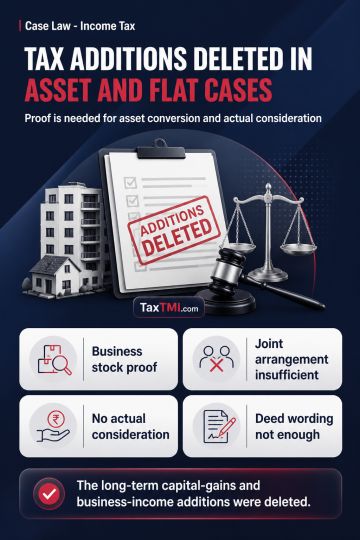
Capital Asset Conversion Requires Proven Business Stock Treatment; Paper Consideration in Spousal Flat Transfers Does Not Create Taxable Business Inco...
Human-probability test defeats political donation deduction where banking records mask accommodation-entry fund layering and evidence shows non-genuin...
Commercial property status protects capital-gains exemption when residential-house ownership limits are tested, while agricultural-land character gove...
Investigation deposits refunded after failed customs demands fall outside the statutory appellate pre-deposit interest regime and may attract compensa...
Resolution plan finality extinguishes unquantified operational-creditor claims and pending proceedings unless the approved plan expressly preserves th...
The HC held the writ petitions maintainable despite alternative remedies, as the impugned orders were passed in disregard of a binding CESTAT decision, resulting in lack of jurisdiction. The dispute concerned classification of imported wheat flour and wheat gluten under DFIA licences and eligibility for exemption. The HC noted that CESTAT had already held wheat flour and wheat gluten fall under the same classification, and the respondent was bound by that finding. Section 131BA(3) was interpreted as confined to parties to those proceedings, not erga omnes. Consequently, the respondent could not ignore CESTAT and take a contrary view. The impugned orders, having solely proceeded on an incorrect classification, were quashed. The HC clarified that the Department may challenge CESTAT's view in appropriate appellate proceedings, but until then, assessing authorities remain bound by it. All petitions were allowed.
The HC held the writ petitions maintainable despite alternative remedies, as the impugned orders were passed in disregard of a binding CESTAT decision, resulting in lack of jurisdiction. The dispute concerned classification of imported wheat flour and wheat gluten under DFIA licences and eligibility for exemption. The HC noted that CESTAT had already held wheat flour and wheat gluten fall under the same classification, and the respondent was bound by that finding. Section 131BA(3) was interpreted as confined to parties to those proceedings, not erga omnes. Consequently, the respondent could not ignore CESTAT and take a contrary view. The impugned orders, having solely proceeded on an incorrect classification, were quashed. The HC clarified that the Department may challenge CESTAT's view in appropriate appellate proceedings, but until then, assessing authorities remain bound by it. All petitions were allowed.
Note: It is a system-generated summary and is for quick reference only.
 TaxTMI
  TaxTMI
 of 4884