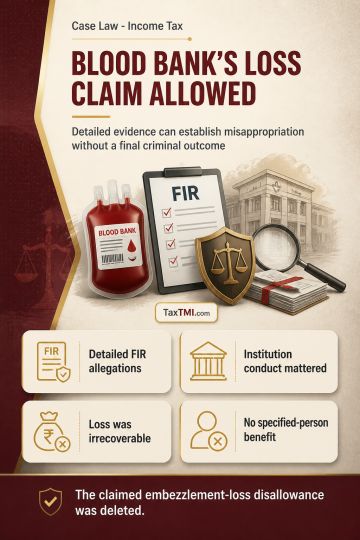
Embezzlement losses in charitable institutions remain allowable when misappropriation is established, irrecoverable, and not a specified-person benefi...
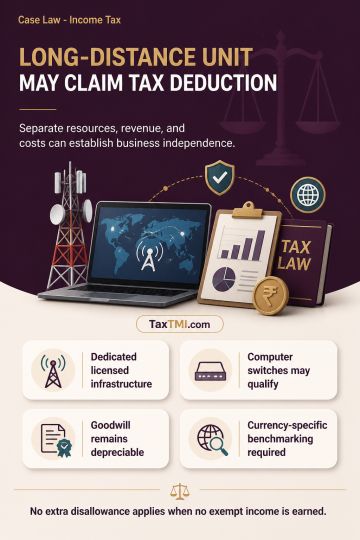
National long-distance undertaking status supports deduction where separately licensed infrastructure, resources, revenue, and expenditure establish c...
Agency reimbursement income follows contractual deposit-liability computation, while pending deposit collections do not constitute deemed-dividend loa...
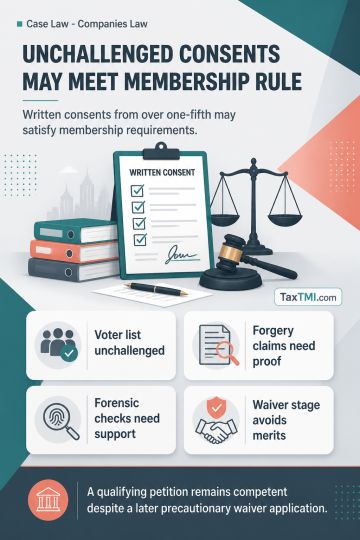
Membership-consent thresholds for oppression petitions are satisfied by unchallenged voter-list consents, while unsupported forgery claims require pro...
ITAT holds that, applying the ICAI Guidance Note on Real Estate Accounting (Revised 2012), land and development rights qualify as direct project costs but must be excluded when determining the 25% construction-and-development-cost threshold to trigger revenue recognition under the Percentage of Completion Method (POCM); once that threshold is met using construction and development costs, total project costs (including land) determine stage of completion and revenue to be recognized. The taxpayer's POCM application was correct: Phase-1 exceeded the 25% threshold whereas Phase-2A did not (19.5205%), and unreconciled revenue was recognized in subsequent years at unchanged tax rates. Absent evidence of deliberate evasion or inconsistent accounting, ITAT found the AO and lower authority's additions unjustified, directed vacatur of those additions and allowed the taxpayer's appeal.
ITAT holds that, applying the ICAI Guidance Note on Real Estate Accounting (Revised 2012), land and development rights qualify as direct project costs but must be excluded when determining the 25% construction-and-development-cost threshold to trigger revenue recognition under the Percentage of Completion Method (POCM); once that threshold is met using construction and development costs, total project costs (including land) determine stage of completion and revenue to be recognized. The taxpayer's POCM application was correct: Phase-1 exceeded the 25% threshold whereas Phase-2A did not (19.5205%), and unreconciled revenue was recognized in subsequent years at unchanged tax rates. Absent evidence of deliberate evasion or inconsistent accounting, ITAT found the AO and lower authority's additions unjustified, directed vacatur of those additions and allowed the taxpayer's appeal.
Note: It is a system-generated summary and is for quick reference only.
 TaxTMI
  TaxTMI
 of 4886