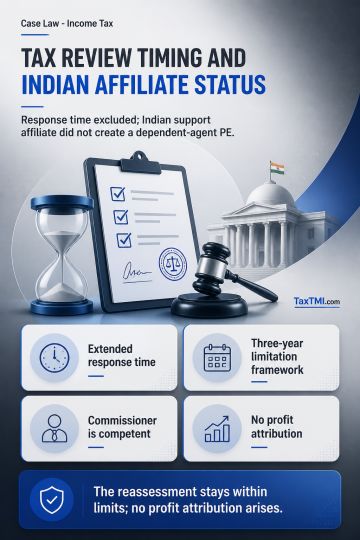
Supervisory permanent establishment requires project-wise duration and qualifying construction nexus; offshore supplies and salary reimbursements rema...
The HC dismissed the petitions for lack of maintainability, holding that petitioners failed to justify bypassing the statutory requirement to exhaust alternative remedies against assessment orders and had falsely averred the absence of any effective remedy. The Court observed that GST liability under Joint Development Agreements raises fact-intensive issues-requiring examination of the agreement terms and factual matrix-which are appropriately determined by the appellate authorities under the Act. No breach of natural justice was alleged. Relying on established precedents concerning exhaustion of remedies, the Court declined to entertain the writ petitions but granted petitioners liberty to institute statutory appeals against the impugned assessment orders.
The HC dismissed the petitions for lack of maintainability, holding that petitioners failed to justify bypassing the statutory requirement to exhaust alternative remedies against assessment orders and had falsely averred the absence of any effective remedy. The Court observed that GST liability under Joint Development Agreements raises fact-intensive issues-requiring examination of the agreement terms and factual matrix-which are appropriately determined by the appellate authorities under the Act. No breach of natural justice was alleged. Relying on established precedents concerning exhaustion of remedies, the Court declined to entertain the writ petitions but granted petitioners liberty to institute statutory appeals against the impugned assessment orders.
Note: It is a system-generated summary and is for quick reference only.
 TaxTMI
  TaxTMI
 of 4881