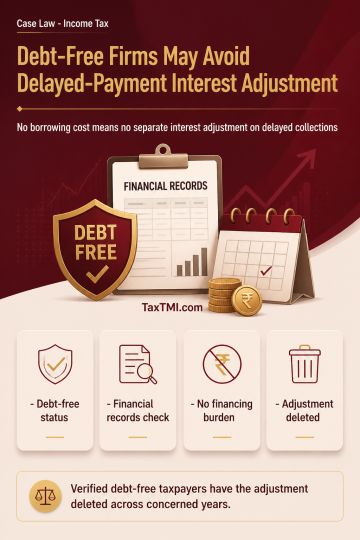
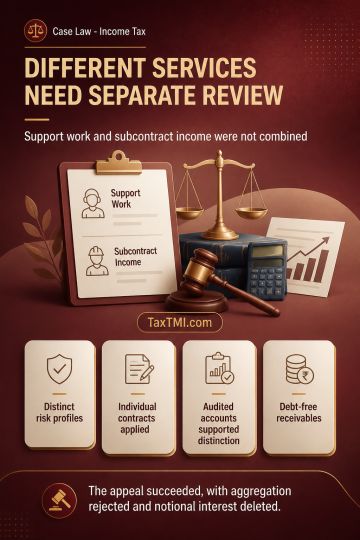
Transfer-pricing aggregation of distinct support-service and subcontract transactions was rejected, while debt-free receivables attracted no notional ...
Page of 4883
Press 'Enter' after typing page number.
121 to 140 of 97649 Results
❮
❯
❯❯
0 / 200
Expand Note
Add to Folder
No Folders have been created
+
Are you sure you want to delete "My most important" ?
The HC ruled that for Section 201(1) proceedings the statutory six-year period (adopted as the reasonable yardstick) governs the limitation inquiry, rejecting a blanket seven-year or one-size-fits-all approach and criticizing Revenue delay. Applying the six-year reckoning, the order for AY 2010-11 was set aside as time-barred; the order for AY 2011-12 was held valid as within the limitation period; orders for the remaining assessment years (subsequent four years) were set aside for being passed beyond six years. The court therefore quashed time-barred Section 201 orders and upheld only the order falling within the six-year limitation.
The HC ruled that for Section 201(1) proceedings the statutory six-year period (adopted as the reasonable yardstick) governs the limitation inquiry, rejecting a blanket seven-year or one-size-fits-all approach and criticizing Revenue delay. Applying the six-year reckoning, the order for AY 2010-11 was set aside as time-barred; the order for AY 2011-12 was held valid as within the limitation period; orders for the remaining assessment years (subsequent four years) were set aside for being passed beyond six years. The court therefore quashed time-barred Section 201 orders and upheld only the order falling within the six-year limitation.
Note: It is a system-generated summary and is for quick reference only.
 TaxTMI
  TaxTMI
 of 4883