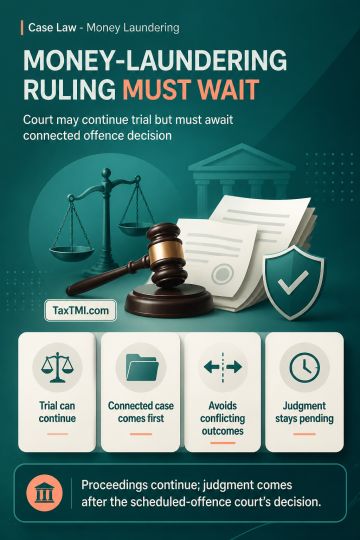
Money-laundering judgment timing requires awaiting the scheduled-offence decision despite continuation of the underlying trial where outcomes directly...
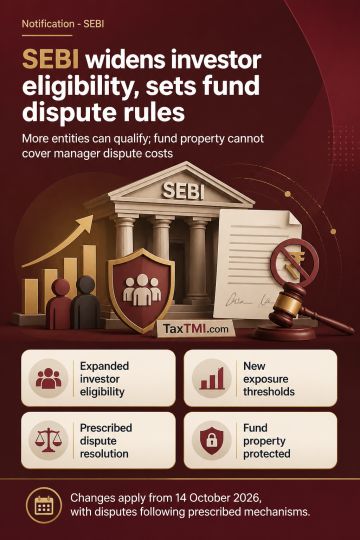
Accredited investor eligibility expands through securities-market exposure, while alternative investment fund disputes require prescribed resolution a...
Customs Assessment Portal centralises classification and valuation guidance to support consistent, transparent and informed compliance across stakehol...
The HC held that the impugned penalty levy under s.125, GST Act, was vitiated for denial of audi alteram partem; noting that an appeal had been dismissed as time-barred, the court nevertheless quashed the orders dated 18.12.2024 and 28.07.2025 for failure to afford an opportunity of hearing. The petition is allowed by way of remand: the matter is returned to the competent authority to rehear and pass a fresh adjudicatory order in accordance with law and principles of natural justice. Directions ensure fresh proceedings conform to statutory limitation rules and afford the Applicant a full opportunity to be heard before any fresh penalty is imposed.
The HC held that the impugned penalty levy under s.125, GST Act, was vitiated for denial of audi alteram partem; noting that an appeal had been dismissed as time-barred, the court nevertheless quashed the orders dated 18.12.2024 and 28.07.2025 for failure to afford an opportunity of hearing. The petition is allowed by way of remand: the matter is returned to the competent authority to rehear and pass a fresh adjudicatory order in accordance with law and principles of natural justice. Directions ensure fresh proceedings conform to statutory limitation rules and afford the Applicant a full opportunity to be heard before any fresh penalty is imposed.
Note: It is a system-generated summary and is for quick reference only.
 TaxTMI
  TaxTMI
 of 4920