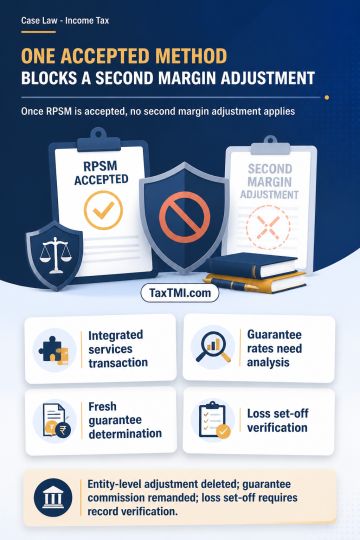
Form 26AS evidence requires successor-entity accounting verification after business transfer, while invoice-supported related-party advertising expend...
Money-laundering judgment timing requires awaiting the scheduled-offence decision despite continuation of the underlying trial where outcomes directly...
Accredited investor eligibility expands through securities-market exposure, while alternative investment fund disputes require prescribed resolution a...
Page of 4916
Press 'Enter' after typing page number.
41 to 60 of 98302 Results
❮
❯
❯❯
0 / 200
Expand Note
Add to Folder
No Folders have been created
+
Are you sure you want to delete "My most important" ?
The CESTAT allowed the appeal, setting aside the penalty imposed under Section 117 of the Customs Act, 1962, for alleged mis-declaration on airway bills relating to 43 consignments. The Tribunal held that the violation pertained solely to the Foreign Trade Policy, which falls outside the scope of Section 117, applicable only to contraventions of the Customs Act. The Commissioner erred by invoking an incorrect sub-section of Section 50 regarding document authority rather than accuracy of export information. Furthermore, no mis-declaration was found in the shipping bills, which contained correct descriptions. The penalty was unsustainable as the appellant was not properly notified of the specific contravention. Consequently, since no Customs Act provision was breached, the appellant-exporter could not be penalized under Section 117, and the impugned order was quashed.
The CESTAT allowed the appeal, setting aside the penalty imposed under Section 117 of the Customs Act, 1962, for alleged mis-declaration on airway bills relating to 43 consignments. The Tribunal held that the violation pertained solely to the Foreign Trade Policy, which falls outside the scope of Section 117, applicable only to contraventions of the Customs Act. The Commissioner erred by invoking an incorrect sub-section of Section 50 regarding document authority rather than accuracy of export information. Furthermore, no mis-declaration was found in the shipping bills, which contained correct descriptions. The penalty was unsustainable as the appellant was not properly notified of the specific contravention. Consequently, since no Customs Act provision was breached, the appellant-exporter could not be penalized under Section 117, and the impugned order was quashed.
Note: It is a system-generated summary and is for quick reference only.
 TaxTMI
 TaxTMI

 of 4916