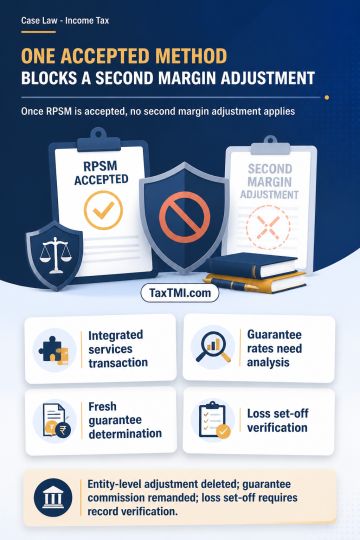
Form 26AS evidence requires successor-entity accounting verification after business transfer, while invoice-supported related-party advertising expend...
Money-laundering judgment timing requires awaiting the scheduled-offence decision despite continuation of the underlying trial where outcomes directly...
Accredited investor eligibility expands through securities-market exposure, while alternative investment fund disputes require prescribed resolution a...
Page of 4916
Press 'Enter' after typing page number.
41 to 60 of 98302 Results
❮
❯
❯❯
0 / 200
Expand Note
Add to Folder
No Folders have been created
+
Are you sure you want to delete "My most important" ?
The NCLAT allowed the appeal, setting aside the NCLT's rejection of the resolution plan despite its approval by 98.57% of the CoC, emphasizing that the adjudicating authority cannot substitute its commercial wisdom for that of the CoC absent contravention of law or public interest. The Tribunal found no procedural impropriety by the RP in managing the CIRP or safeguarding corporate assets, rejecting adverse findings without conclusive evidence on title issues. It held that valuation and financial considerations fall within the CoC's domain and are not subject to judicial re-evaluation. The NCLAT directed the adjudicating authority to remit the resolution plan to the CoC for reconsideration in light of earlier raised queries, endorsing the CoC's prerogative to convene meetings post-approval pending adjudicatory sanction. The impugned order was quashed, restoring the primacy of the CoC's commercial decision-making under the IBC framework.
The NCLAT allowed the appeal, setting aside the NCLT's rejection of the resolution plan despite its approval by 98.57% of the CoC, emphasizing that the adjudicating authority cannot substitute its commercial wisdom for that of the CoC absent contravention of law or public interest. The Tribunal found no procedural impropriety by the RP in managing the CIRP or safeguarding corporate assets, rejecting adverse findings without conclusive evidence on title issues. It held that valuation and financial considerations fall within the CoC's domain and are not subject to judicial re-evaluation. The NCLAT directed the adjudicating authority to remit the resolution plan to the CoC for reconsideration in light of earlier raised queries, endorsing the CoC's prerogative to convene meetings post-approval pending adjudicatory sanction. The impugned order was quashed, restoring the primacy of the CoC's commercial decision-making under the IBC framework.
Note: It is a system-generated summary and is for quick reference only.
 TaxTMI
 TaxTMI

 of 4916