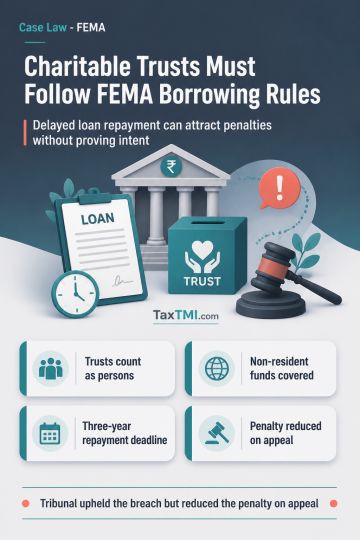
FEMA borrowing restrictions bind charitable trusts, and civil penalties apply without proving intent for delayed repayment of non-resident rupee loans...
The ITAT held that the penalty under section 271(1)(c) was unsustainable as the Assessing Officer failed to record satisfaction specifically whether the assessee concealed particulars of income or furnished inaccurate particulars, a mandatory precondition for initiating penalty proceedings. The AO issued the notice under section 274 read with section 271(1)(c) in a standard proforma without deleting irrelevant portions, indicating non-application of mind. Consequently, the penalty notice was invalid for lack of clarity and specificity, denying the assessee adequate opportunity to respond. The tribunal quashed the penalty order, allowing the appeal, reaffirming that proper satisfaction and clear specification of charge are essential prerequisites before imposing penalty under section 271(1)(c).
The ITAT held that the penalty under section 271(1)(c) was unsustainable as the Assessing Officer failed to record satisfaction specifically whether the assessee concealed particulars of income or furnished inaccurate particulars, a mandatory precondition for initiating penalty proceedings. The AO issued the notice under section 274 read with section 271(1)(c) in a standard proforma without deleting irrelevant portions, indicating non-application of mind. Consequently, the penalty notice was invalid for lack of clarity and specificity, denying the assessee adequate opportunity to respond. The tribunal quashed the penalty order, allowing the appeal, reaffirming that proper satisfaction and clear specification of charge are essential prerequisites before imposing penalty under section 271(1)(c).
Note: It is a system-generated summary and is for quick reference only.
 TaxTMI
  TaxTMI
 of 4886