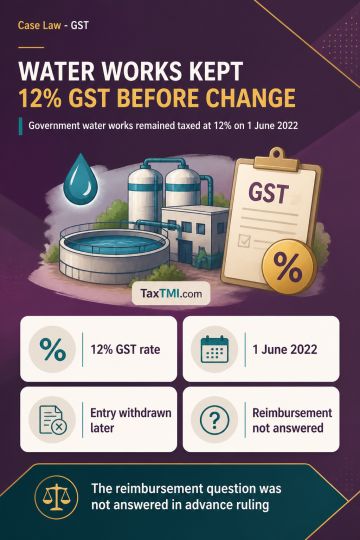
Government water works contract GST concession applied before its withdrawal, while contractual tax reimbursement claims lay outside advance-ruling sc...
Page of 4888
Press 'Enter' after typing page number.
461 to 480 of 97755 Results
❮
❯
❯❯
0 / 200
Expand Note
Add to Folder
No Folders have been created
+
Are you sure you want to delete "My most important" ?
The HC set aside the impugned order rejecting the petitioner's revised TRAN-1 form under Section 140 of the CGST Act, 2017. The court held that the petitioner could not have electronically revised excise returns filed prior to 1 July 2017 after the GST regime commenced, as the excise portal was non-functional post that date. Consequently, the rejection based on the absence of electronic filing was unsustainable. Additionally, the petitioner's manual revision and claim for transitional credit, made within one year as stipulated under the Cenvat Credit Rules, 2004, was valid. The petitioner's prompt notification to GST authorities upon discovering the error further supported entitlement to credit. The HC concluded there was no infirmity in the petitioner's claim, allowing the transition of enhanced credit under GST. The petition was disposed of accordingly.
The HC set aside the impugned order rejecting the petitioner's revised TRAN-1 form under Section 140 of the CGST Act, 2017. The court held that the petitioner could not have electronically revised excise returns filed prior to 1 July 2017 after the GST regime commenced, as the excise portal was non-functional post that date. Consequently, the rejection based on the absence of electronic filing was unsustainable. Additionally, the petitioner's manual revision and claim for transitional credit, made within one year as stipulated under the Cenvat Credit Rules, 2004, was valid. The petitioner's prompt notification to GST authorities upon discovering the error further supported entitlement to credit. The HC concluded there was no infirmity in the petitioner's claim, allowing the transition of enhanced credit under GST. The petition was disposed of accordingly.
Note: It is a system-generated summary and is for quick reference only.
 TaxTMI
  TaxTMI
 of 4888