Food import sampling requirements support provisional release where unseized consignments conform to standards and raw areca classification is unestab...
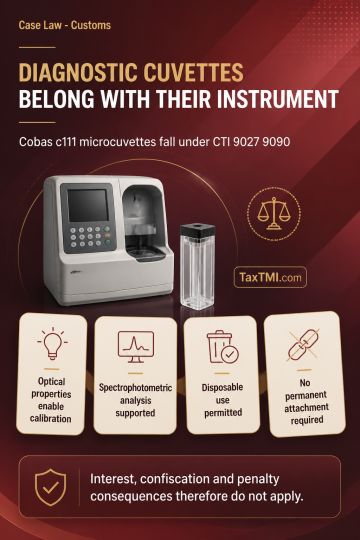
Diagnostic microcuvette classification follows sole-use analytical function, placing specialised disposable cuvettes with their analyser rather than g...
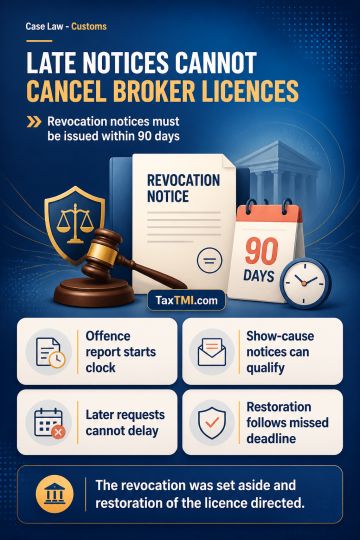
Customs Broker licensing proceedings fail when their offence-report foundation collapses and authorisation, advisory, and KYC duties remain unbreached...
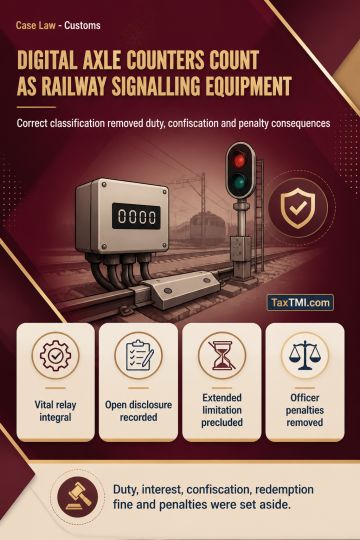
Tariff classification of Digital Axle Counters affirmed as electro-mechanical railway signalling equipment, eliminating duty, confiscation and penalty...
The HC set aside the impugned order rejecting the petitioner's revised TRAN-1 form under Section 140 of the CGST Act, 2017. The court held that the petitioner could not have electronically revised excise returns filed prior to 1 July 2017 after the GST regime commenced, as the excise portal was non-functional post that date. Consequently, the rejection based on the absence of electronic filing was unsustainable. Additionally, the petitioner's manual revision and claim for transitional credit, made within one year as stipulated under the Cenvat Credit Rules, 2004, was valid. The petitioner's prompt notification to GST authorities upon discovering the error further supported entitlement to credit. The HC concluded there was no infirmity in the petitioner's claim, allowing the transition of enhanced credit under GST. The petition was disposed of accordingly.
The HC set aside the impugned order rejecting the petitioner's revised TRAN-1 form under Section 140 of the CGST Act, 2017. The court held that the petitioner could not have electronically revised excise returns filed prior to 1 July 2017 after the GST regime commenced, as the excise portal was non-functional post that date. Consequently, the rejection based on the absence of electronic filing was unsustainable. Additionally, the petitioner's manual revision and claim for transitional credit, made within one year as stipulated under the Cenvat Credit Rules, 2004, was valid. The petitioner's prompt notification to GST authorities upon discovering the error further supported entitlement to credit. The HC concluded there was no infirmity in the petitioner's claim, allowing the transition of enhanced credit under GST. The petition was disposed of accordingly.
Note: It is a system-generated summary and is for quick reference only.
 TaxTMI
  TaxTMI
 of 4886