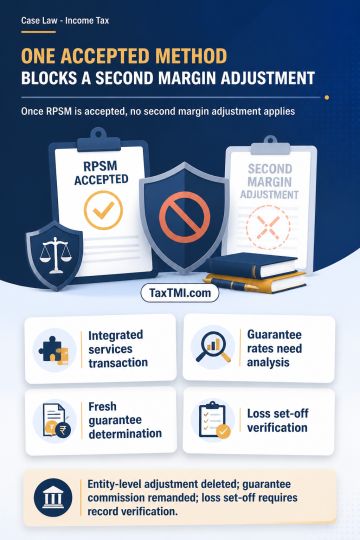
Form 26AS evidence requires successor-entity accounting verification after business transfer, while invoice-supported related-party advertising expend...
Money-laundering judgment timing requires awaiting the scheduled-offence decision despite continuation of the underlying trial where outcomes directly...
Accredited investor eligibility expands through securities-market exposure, while alternative investment fund disputes require prescribed resolution a...
Page of 4916
Press 'Enter' after typing page number.
41 to 60 of 98302 Results
❮
❯
❯❯
0 / 200
Expand Note
Add to Folder
No Folders have been created
+
Are you sure you want to delete "My most important" ?
ITAT allowed the appeal, holding that the AO's recharacterization of business income as "income from other sources" was legally unsustainable without contrary material evidence. The assessee, a software and networking solutions company, had legitimate revenue from identifiable clients under valid tax invoices. The AO failed to produce incriminating material during search or evidence contradicting the business activities. The tribunal emphasized that quantum of income does not determine business genuineness, noting the assessee's consistent IT business operations accepted in prior assessments. The disallowance of business expenses was unjustified absent findings of bogus or unrelated expenditure. Applying the principle of consistency from Radhasoami Satsang, the tribunal ruled that treatment accepted in earlier years should not be disturbed without factual changes, directing deletion of additions totaling the disputed amounts.
ITAT allowed the appeal, holding that the AO's recharacterization of business income as "income from other sources" was legally unsustainable without contrary material evidence. The assessee, a software and networking solutions company, had legitimate revenue from identifiable clients under valid tax invoices. The AO failed to produce incriminating material during search or evidence contradicting the business activities. The tribunal emphasized that quantum of income does not determine business genuineness, noting the assessee's consistent IT business operations accepted in prior assessments. The disallowance of business expenses was unjustified absent findings of bogus or unrelated expenditure. Applying the principle of consistency from Radhasoami Satsang, the tribunal ruled that treatment accepted in earlier years should not be disturbed without factual changes, directing deletion of additions totaling the disputed amounts.
Note: It is a system-generated summary and is for quick reference only.
 TaxTMI
 TaxTMI

 of 4916