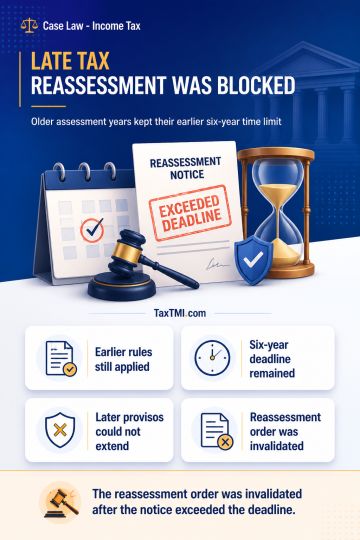
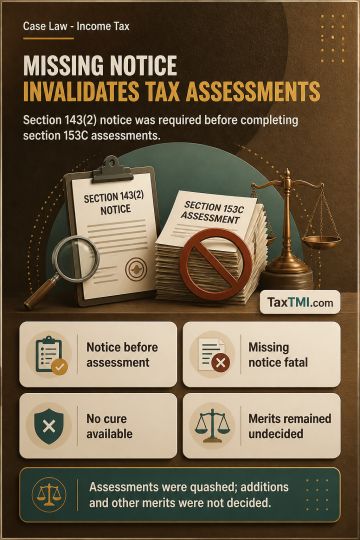
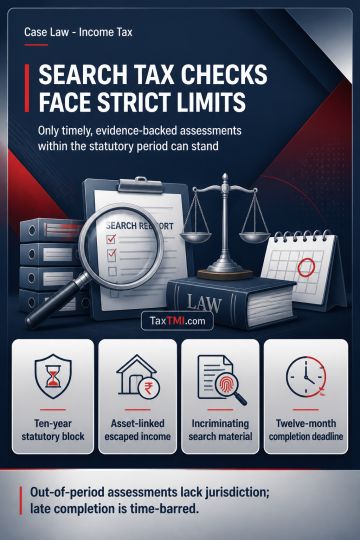
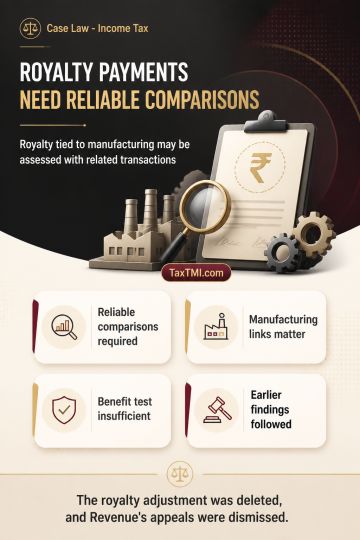
Pre-amendment reassessment limitation bars late notices under the preserved regime, invalidating consequential reassessment for affected earlier asses...
Cash-sales explanations for bank deposits require documentary reconciliation; reassessment notice survived where effective response time was available...
Functional comparability in transfer pricing prevents ad hoc arm's length adjustments where functions, assets, risks and reliable comparables are unes...
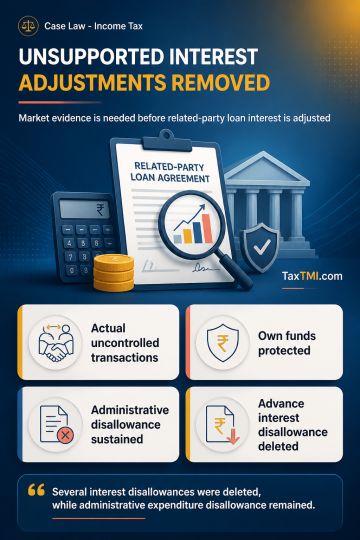
Contingency expenses, exempt-income disallowance, and royalty benchmarking: unsupported adjustments were deleted under consistent accounting and trans...
Page of 4920
Press 'Enter' after typing page number.
61 to 80 of 98394 Results
❮
❯
❯❯
0 / 200
Expand Note
Add to Folder
No Folders have been created
+
Are you sure you want to delete "My most important" ?
CESTAT allowed the appeal against confiscation of imported goods and penalty imposition. The appellant had discharged duty liability on current and past imports by August 2013, yet goods were seized later without proper show cause notice under section 124 of Customs Act, 1962. The tribunal found no allegation of post-importation condition breaches and noted section 3 of Customs Tariff Act, 1975 does not extend to declarations made by importers. The original authority failed to establish grounds for invoking section 111(m) regarding different valuation requirements. Since appellant immediately rectified differential duty liability when advised goods should be assessed on retail sale price rather than transaction value, and discharged all duties with interest, no justification existed for sustaining confiscation under section 111 or penalty under section 112 of Customs Act, 1962.
CESTAT allowed the appeal against confiscation of imported goods and penalty imposition. The appellant had discharged duty liability on current and past imports by August 2013, yet goods were seized later without proper show cause notice under section 124 of Customs Act, 1962. The tribunal found no allegation of post-importation condition breaches and noted section 3 of Customs Tariff Act, 1975 does not extend to declarations made by importers. The original authority failed to establish grounds for invoking section 111(m) regarding different valuation requirements. Since appellant immediately rectified differential duty liability when advised goods should be assessed on retail sale price rather than transaction value, and discharged all duties with interest, no justification existed for sustaining confiscation under section 111 or penalty under section 112 of Customs Act, 1962.
Note: It is a system-generated summary and is for quick reference only.
 TaxTMI
 TaxTMI

 of 4920