Loading...

⚠ ✕
❮ Top
☎ Help
☰
×

By creating an account you can:

Logo TaxTMI
Call Us / Help / Feedback✕

Contact Us At :

✉ E-mail: [email protected]

✆ Call / WhatsApp at: +91 99117 96707

For more information, Check Contact Us

FAQs :

To know Frequently Asked Questions, Check FAQs

Most Asked Video Tutorials :

For more tutorials, Check Video Tutorials

Submit Feedback/Suggestion :

Email :
Please provide your email address so we can follow up on your feedback.
Category :
Description :
Min 15 characters 0/2000
Make Most of Text Search ✕
  1. Checkout this video tutorial: How to search effectively on TaxTMI.
  2. Put words in double quotes for exact word search, eg: "income tax"
  3. Avoid noise words such as : 'and, of, the, a'
  4. Sort by Relevance to get the most relevant document.
  5. Press Enter to add multiple terms/multiple phrases, and then click on Search to Search.
  6. Text Search
  7. The system will try to fetch results that contains ALL your words.
  8. Once you add keywords, you'll see a new 'Search In' filter that makes your results even more precise.
  9. Text Search
╳
Add to...
You have not created any category. Kindly create one to bookmark this item!
✕
Create New Category
Hide
Title :
Description :
❮❮ Hide
❮ Default View
Expand ❯❯
Close ✕
🔎 Filters / Advanced Search ❯
TEXT

Press 'Enter' to add multiple search terms. Rules for Better Search

Search In
Main Text + AI Text ❯
  • Main Text
  • Main Text + AI Text
  • AI Text
Law:
---- All Laws---- ❯
  • ---- All Laws----
  • Income Tax
  • Direct Taxes
  • Benami Property
  • Central GST Laws
  • SGST - State GST Laws
  • Customs
  • FTP - Foreign Trade Policy
  • SEZ - Special Economic Zone
  • FEMA - Foreign Exchange Management
  • Companies Law
  • SEBI - Securities & Exchange Board of India
  • IBC - Insolvency and Bankruptcy
  • Law of Competition
  • PMLA - Money-Laundering
  • Indian Laws
  • Bill / Finance Bills
  • Wealth Tax
  • Service Tax
  • Central Excise
  • VAT / Sales Tax
Month:
---- All Months ---- ❯
  • ---- All Months ----
  • January
  • February
  • March
  • April
  • May
  • June
  • July
  • August
  • September
  • October
  • November
  • December
Year:
---- All Years ---- ❯
  • ---- All Years ----
  • 2026
  • 2025
  • 2024
  • 2023
  • 2022
  • 2021
  • 2020
  • 2019
  • 2018
  • 2017
  • 2016
  • 2015
  • 2014
  • 2013
  • 2012
  • 2011
Sort By: ?
In Sort By 'Default', exact matches for text search are shown at the top, followed by the remaining results in their regular order.
Relevance Default Date
☰   Show Results ❯
    Actual receipt of goods governs input tax credit claims, requiring cumulative evidence and reasoned verification rather than invoice reliance alone.
    Curable GST pre-deposit defects require an opportunity to correct cash-ledger allocation before an amnesty appeal is rejected.
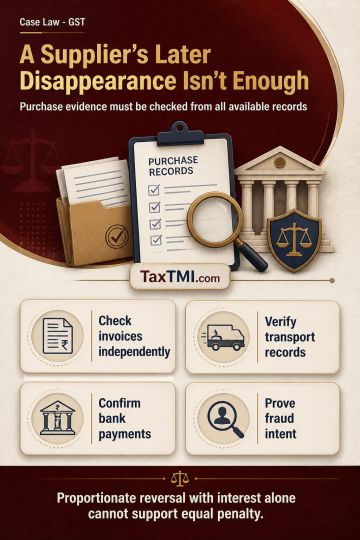
    Input tax credit claims require evidence beyond a supplier's later non-existence and unsupported fraud allegations.
    GST Transit Penalties Require Proof of Existing Contravention; Route Deviation and Uncorroborated Delivery Allegations Are Insufficient.
    Compensation Cess credit refunds require statutory inverted-tax-structure eligibility; admissible coal credit alone cannot support refunds on domestic...
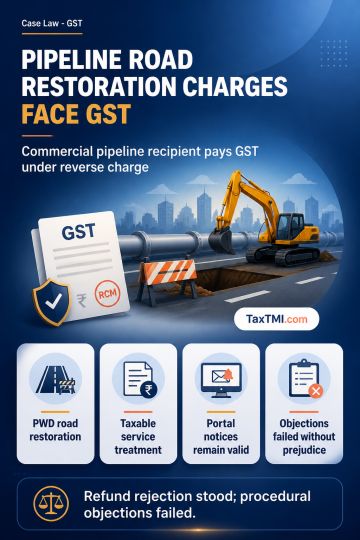
    Road restoration charges for commercial pipeline work attract reverse-charge GST; portal-only proceedings remain valid without a physical DIN.
    Opportunity to furnish unsecured-loan confirmations is required before reassessment initiation; proceedings require fresh consideration after taxpayer...
    Reassessment approval without examining loan evidence invalidates proceedings and requires fresh consideration of alleged undisclosed turnover.
    Transfer-pricing valuation requires associated-enterprise status and a prescribed method; research and software deductions depend on business nexus.
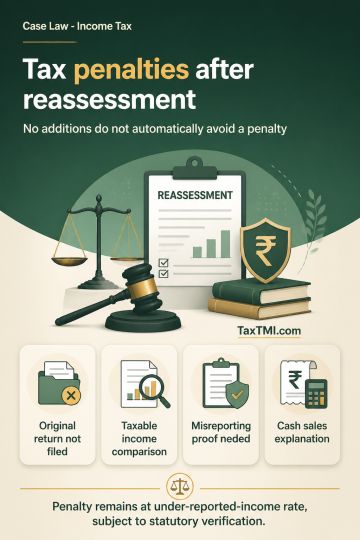
    Under-reporting on a first reassessment return attracts penalty, while enhanced misreporting penalty requires proof of a statutory misreporting catego...
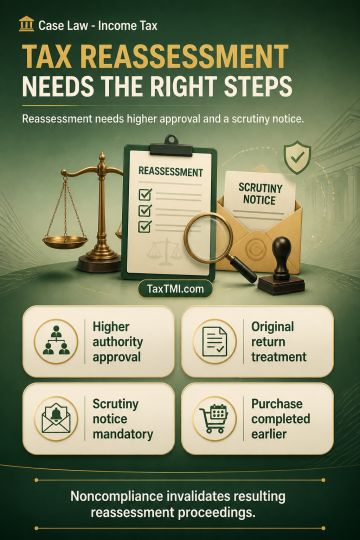
    Reassessment approval requires prescribed authority, and failure to issue mandatory scrutiny notice invalidates the resulting assessment proceedings.
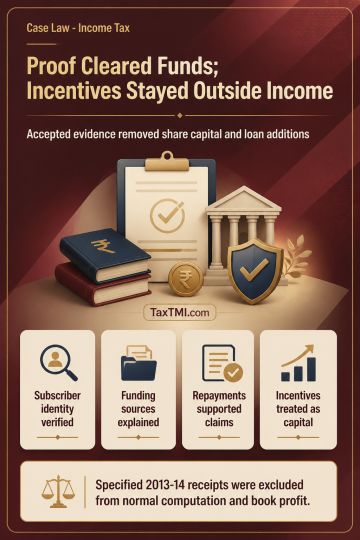
    Section 68 evidence standards require deletion of share capital and loan additions when identity, creditworthiness and genuineness are established.
    Bad-debt write-offs and related-party rent: deductions sustained where receivables were written off and no market-value excess was shown.
    Presumptive taxation classification supports business treatment for global ranking support services over professional income estimation.
    Taxability of non-resident commissions governs TDS, while a missing residency certificate alone cannot create Indian tax liability.
    Genuineness of charitable activities requires transparent donation sources and identifiable public beneficiaries for registration renewal.
    Reasonable cause for cash property advances can avert penalties despite specified-sum restrictions and disclosure requirements.
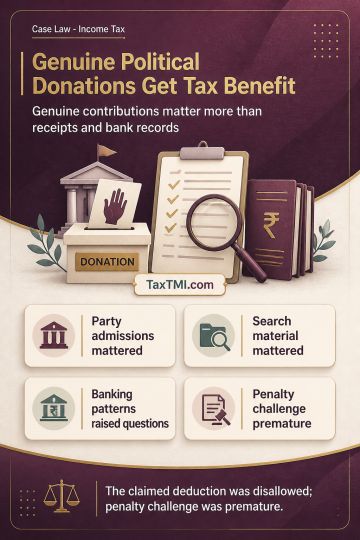
    Political contribution genuineness governs deduction where accommodation-entry evidence defeats banking records and makes penalty challenge premature.
    Profit-element additions for non-genuine metal purchases apply where related sales are undisputed, reducing the purchase-based addition.
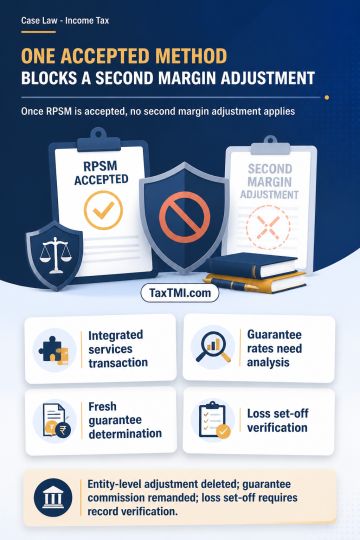
    Residual profit split method bars a second entity-level margin adjustment for the same integrated services transaction.
❮
❯
❯❯
Maximize Maximize Maximize
0 / 200
Expand Note
Add to Folder

No Folders have been created

+

Are you sure you want to delete "My most important" ?

NOTE:

Highlights
Showing Results for :
Reset Filters
Results Found:
Show All Summaries Hide All Summaries

Highlights

Back

All Highlights

Showing Results for :
Reset Filters
No Records Found

Highlights

Back

All Highlights

SEBI mandates standardized, validated UPI IDs for payment...

SEBI Introduces Standardized UPI IDs for Market Intermediaries to Enhance Payment Security and Investor Protection

Contents
Summary
Note

Note

-

Bookmark

Print

Print

SEBI June 12, 2025 Circulars
SEBI mandates standardized, validated UPI IDs for payment collection by registered market intermediaries, establishing a structured mechanism to enhance payment security and investor protection. The circular introduces a unique "@valid" UPI handle format for intermediaries, requiring them to obtain exclusive payment identifiers through designated self-certified syndicate banks. Intermediaries must generate standardized UPI IDs with specific username suffixes representing their market segment, implement a verification mechanism through "SEBI Check" functionality, and create investor awareness about the new payment system. The new UPI ID framework will be operational from October 01, 2025, with mandatory implementation timelines for market infrastructure institutions, banks, and investor-facing intermediaries, aimed at creating a more transparent and secure payment ecosystem in the securities market.

Topics

Acts Income Tax