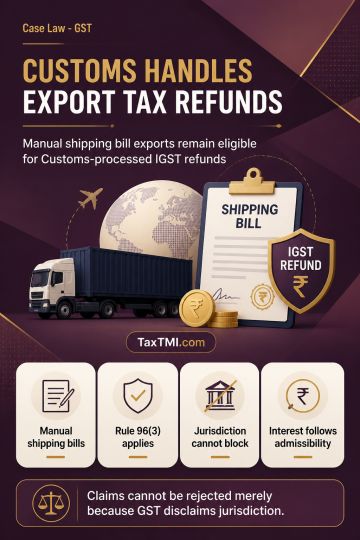
GST refunds for cancelled air tickets remain available when passenger reimbursements defeat unjust enrichment and credit-note adjustment is unavailabl...
HC allowed the assessee's appeal, finding the reassessment notice invalid. The Assessing Officer (AO) could not establish specific evidence of tax evasion, merely relying on general information about penny stock transactions. The court held that "reason to believe" cannot be equated with "reason to suspect" and that reopening assessment requires tangible material demonstrating income escape. The AO's conclusion about bogus short-term capital loss was based on insufficient suspicion derived from Investigation Wing's report, without concrete proof of the petitioner's direct involvement in tax avoidance scheme. Consequently, the impugned notice was quashed, reinforcing the principle that reassessment cannot be triggered by vague or generalized information.
HC allowed the assessee's appeal, finding the reassessment notice invalid. The Assessing Officer (AO) could not establish specific evidence of tax evasion, merely relying on general information about penny stock transactions. The court held that "reason to believe" cannot be equated with "reason to suspect" and that reopening assessment requires tangible material demonstrating income escape. The AO's conclusion about bogus short-term capital loss was based on insufficient suspicion derived from Investigation Wing's report, without concrete proof of the petitioner's direct involvement in tax avoidance scheme. Consequently, the impugned notice was quashed, reinforcing the principle that reassessment cannot be triggered by vague or generalized information.
Note: It is a system-generated summary and is for quick reference only.
 TaxTMI
  TaxTMI
 of 4918