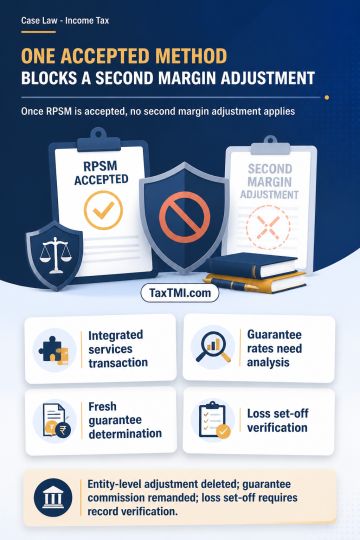
Form 26AS evidence requires successor-entity accounting verification after business transfer, while invoice-supported related-party advertising expend...
Money-laundering judgment timing requires awaiting the scheduled-offence decision despite continuation of the underlying trial where outcomes directly...
Accredited investor eligibility expands through securities-market exposure, while alternative investment fund disputes require prescribed resolution a...
Page of 4916
Press 'Enter' after typing page number.
41 to 60 of 98302 Results
❮
❯
❯❯
0 / 200
Expand Note
Add to Folder
No Folders have been created
+
Are you sure you want to delete "My most important" ?
CESTAT adjudicated a service tax dispute involving jurisdictional challenges and tax exemption claims. The tribunal rejected arguments challenging the Assistant Commissioner's authority, emphasizing operational continuity in tax administration. The court clarified Article 12's limited applicability to fundamental rights and dismissed misinterpretations regarding state definition. Regarding exemption claims under Notification No. 25/2012-ST, the tribunal determined that market infrastructure structures were primarily commercial, thus ineligible for tax exemption. The tribunal found the appellant's conduct indicative of tax evasion, consequently upholding the extended limitation period, service tax demand, and penalty under sections 73, 75, and 77 of the Finance Act. The appeal was ultimately dismissed, confirming the original tax assessment and penalties.
CESTAT adjudicated a service tax dispute involving jurisdictional challenges and tax exemption claims. The tribunal rejected arguments challenging the Assistant Commissioner's authority, emphasizing operational continuity in tax administration. The court clarified Article 12's limited applicability to fundamental rights and dismissed misinterpretations regarding state definition. Regarding exemption claims under Notification No. 25/2012-ST, the tribunal determined that market infrastructure structures were primarily commercial, thus ineligible for tax exemption. The tribunal found the appellant's conduct indicative of tax evasion, consequently upholding the extended limitation period, service tax demand, and penalty under sections 73, 75, and 77 of the Finance Act. The appeal was ultimately dismissed, confirming the original tax assessment and penalties.
Note: It is a system-generated summary and is for quick reference only.
 TaxTMI
 TaxTMI

 of 4916