Customs-controlled cargo movement now includes GDL, subject to EXIM prioritisation, segregation, verification, reconciliation and enforcement safeguar...
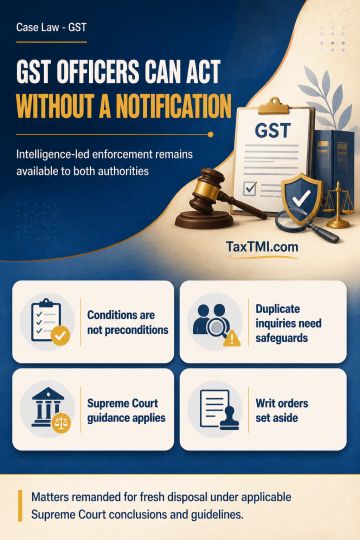
GST cross-empowerment remains effective without conditional notification, while duplicate proceedings require established safeguards against overlappi...
SC held that Section 11 of SARFAESI Act mandates statutory arbitration for disputes between banks, financial institutions, or asset reconstruction companies relating to securitization, reconstruction, or non-payment of dues. The provision creates a legal fiction presuming an arbitration agreement exists without requiring explicit written consent. The court affirmed that the dispute resolution mechanism under Section 11 is mandatory and cannot be circumvented by alternative guidelines. Consequently, the appeal was dismissed, directing the parties to resolve their dispute through arbitration as prescribed under the SARFAESI Act.
SC held that Section 11 of SARFAESI Act mandates statutory arbitration for disputes between banks, financial institutions, or asset reconstruction companies relating to securitization, reconstruction, or non-payment of dues. The provision creates a legal fiction presuming an arbitration agreement exists without requiring explicit written consent. The court affirmed that the dispute resolution mechanism under Section 11 is mandatory and cannot be circumvented by alternative guidelines. Consequently, the appeal was dismissed, directing the parties to resolve their dispute through arbitration as prescribed under the SARFAESI Act.
Note: It is a system-generated summary and is for quick reference only.
 TaxTMI
  TaxTMI
 of 4883