GST refunds for cancelled air tickets remain available when passenger reimbursements defeat unjust enrichment and credit-note adjustment is unavailabl...
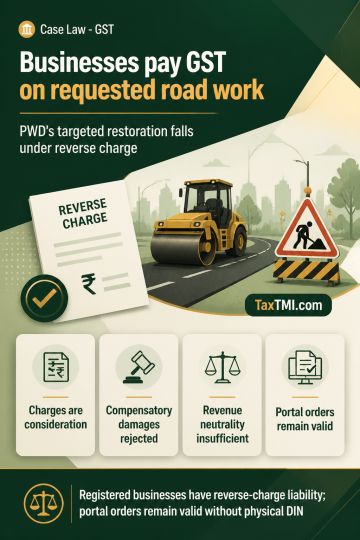
Request-driven road restoration attracts reverse-charge GST, not governmental-function treatment or compensatory-damages status for business recipient...
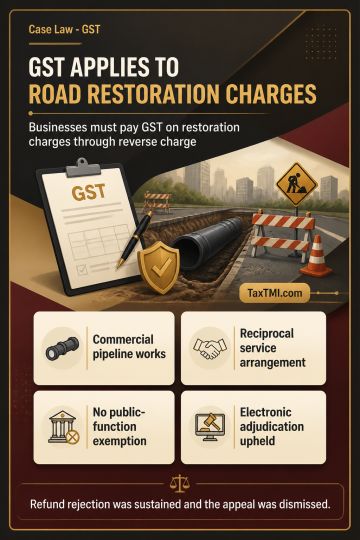
Road restoration charges for commercial pipeline works are taxable Government services, with reverse charge liability and no public-function exemption...
The CCI (Determination of Cost of Production) Regulations, 2025 establish comprehensive guidelines for determining cost in competition law proceedings. The regulations define multiple cost concepts including average variable cost, total cost, and long run average incremental cost, with average variable cost serving as the primary proxy for marginal cost. The CCI retains discretion to consider alternative cost methodologies in specific cases, subject to written justification. The regulations provide mechanisms for expert engagement, confidentiality requests, and preserve continuity with prior regulatory frameworks by ensuring existing proceedings and actions remain valid under the new regulatory structure.
The CCI (Determination of Cost of Production) Regulations, 2025 establish comprehensive guidelines for determining cost in competition law proceedings. The regulations define multiple cost concepts including average variable cost, total cost, and long run average incremental cost, with average variable cost serving as the primary proxy for marginal cost. The CCI retains discretion to consider alternative cost methodologies in specific cases, subject to written justification. The regulations provide mechanisms for expert engagement, confidentiality requests, and preserve continuity with prior regulatory frameworks by ensuring existing proceedings and actions remain valid under the new regulatory structure.
Note: It is a system-generated summary and is for quick reference only.
 TaxTMI
  TaxTMI
 of 4920