Stamp valuation increases after registration-fee payment led to deletion of property-purchase addition within tolerance and without valuation referral...
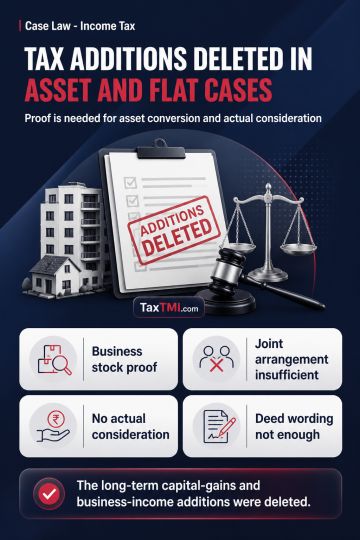
Capital Asset Conversion Requires Proven Business Stock Treatment; Paper Consideration in Spousal Flat Transfers Does Not Create Taxable Business Inco...
CESTAT held that the imported animal feed supplement (Nutracor 88) was correctly classified under CTH 23099090, invalidating the appellant's original classification. The tribunal rejected the revenue's attempt to invoke extended limitation period, finding no suppression of facts or intentional mis-declaration. The court set aside the demands raised under extended limitation, redemption fine, and penalty under Section 114A of the Customs Act. The appellant was required to pay differential duty for the normal limitation period without additional penalties, effectively partially allowing the appeal while maintaining the revised tariff classification.
CESTAT held that the imported animal feed supplement (Nutracor 88) was correctly classified under CTH 23099090, invalidating the appellant's original classification. The tribunal rejected the revenue's attempt to invoke extended limitation period, finding no suppression of facts or intentional mis-declaration. The court set aside the demands raised under extended limitation, redemption fine, and penalty under Section 114A of the Customs Act. The appellant was required to pay differential duty for the normal limitation period without additional penalties, effectively partially allowing the appeal while maintaining the revised tariff classification.
Note: It is a system-generated summary and is for quick reference only.
 TaxTMI
  TaxTMI
 of 4888