Political contribution deductions require genuine transactions; banking records and party registration alone cannot defeat evidence of accommodation e...
Post-death GST liability permits fresh proceedings against legal representatives, while discontinued-business recovery remains limited to the inherite...
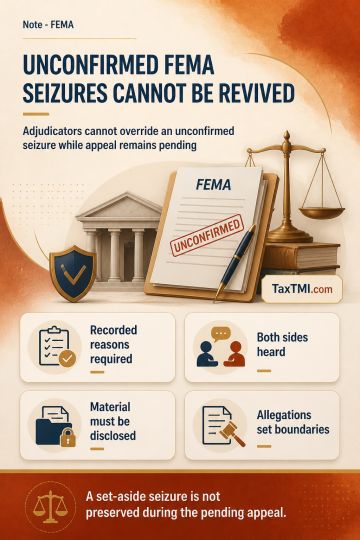
Non-confirmation of FEMA seizure prevents adjudicators from overriding pending appellate findings on recorded reasons and suspected foreign asset hold...
ITAT set aside Pr.CIT's order under section 263, finding procedural irregularities in reassessment proceedings. The tribunal determined that Pr.CIT exceeded jurisdictional limits by: (1) considering documents not available during original examination, (2) introducing issues beyond the original reassessment scope under section 147, and (3) improperly evaluating additional tax-related matters not part of initial proceedings. The tribunal emphasized that revisional powers must be exercised strictly based on records existing at the time of original assessment. Consequently, the entire proceedings were deemed ultra vires, with the appellate order partially allowing the assessee's appeal and nullifying the CIT's interventions.
ITAT set aside Pr.CIT's order under section 263, finding procedural irregularities in reassessment proceedings. The tribunal determined that Pr.CIT exceeded jurisdictional limits by: (1) considering documents not available during original examination, (2) introducing issues beyond the original reassessment scope under section 147, and (3) improperly evaluating additional tax-related matters not part of initial proceedings. The tribunal emphasized that revisional powers must be exercised strictly based on records existing at the time of original assessment. Consequently, the entire proceedings were deemed ultra vires, with the appellate order partially allowing the assessee's appeal and nullifying the CIT's interventions.
Note: It is a system-generated summary and is for quick reference only.
 TaxTMI
  TaxTMI
 of 4918