Pre-amendment reassessment limitation bars late notices under the preserved regime, invalidating consequential reassessment for affected earlier asses...
Cash-sales explanations for bank deposits require documentary reconciliation; reassessment notice survived where effective response time was available...
Functional comparability in transfer pricing prevents ad hoc arm's length adjustments where functions, assets, risks and reliable comparables are unes...
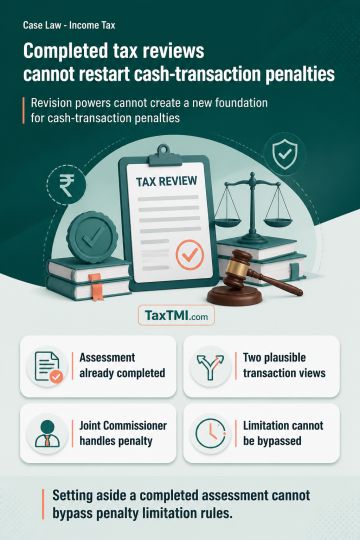
ITAT held that the CIT(E)'s revisional order under Section 263 was unwarranted. The Assessing Officer (AO) had thoroughly examined the trust's activities and found them eligible for exemption under Section 2(15). The tribunal rejected CIT(E)'s contentions regarding investments, corpus donations, and advance tax payments, noting that the AO had already scrutinized these issues during assessment proceedings. The tribunal emphasized that the AO's order was based on a plausible interpretation of the law and in line with the Madras HC's previous decision reinstating the trust's registration. Consequently, the ITAT set aside the CIT(E)'s revisional order, ruling in favor of the assessee.
ITAT held that the CIT(E)'s revisional order under Section 263 was unwarranted. The Assessing Officer (AO) had thoroughly examined the trust's activities and found them eligible for exemption under Section 2(15). The tribunal rejected CIT(E)'s contentions regarding investments, corpus donations, and advance tax payments, noting that the AO had already scrutinized these issues during assessment proceedings. The tribunal emphasized that the AO's order was based on a plausible interpretation of the law and in line with the Madras HC's previous decision reinstating the trust's registration. Consequently, the ITAT set aside the CIT(E)'s revisional order, ruling in favor of the assessee.
Note: It is a system-generated summary and is for quick reference only.
 TaxTMI
 TaxTMI

 of 4918