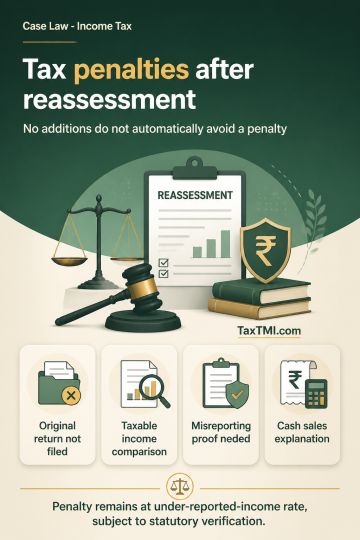
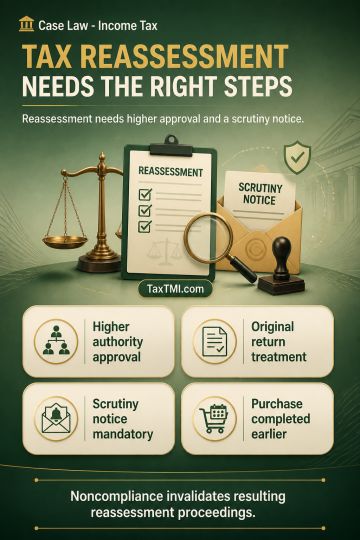
Under-reporting on a first reassessment return attracts penalty, while enhanced misreporting penalty requires proof of a statutory misreporting catego...
Form 26AS evidence requires successor-entity accounting verification after business transfer, while invoice-supported related-party advertising expend...
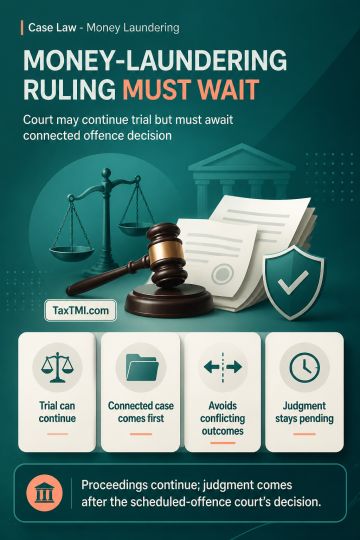
Money-laundering judgment timing requires awaiting the scheduled-offence decision despite continuation of the underlying trial where outcomes directly...
Page of 4921
Press 'Enter' after typing page number.
141 to 160 of 98411 Results
❮
❯
❯❯
0 / 200
Expand Note
Add to Folder
No Folders have been created
+
Are you sure you want to delete "My most important" ?
The CBIC issued comprehensive instructions for processing GST registration applications, establishing clear guidelines for tax officers to streamline and standardize the verification process. Key directives include: (a) accepting one documentary proof for principal place of business ownership, (b) restricting additional document requests, (c) mandating registration approval within 7-30 days depending on risk assessment, and (d) prohibiting presumptive queries unrelated to submitted documents. Officers must carefully scrutinize applications, avoid unnecessary delays, and ensure genuine applicants are not harassed while preventing fraudulent registrations. The instructions aim to create a transparent, efficient GST registration mechanism with defined timelines and reduced administrative discretion.
The CBIC issued comprehensive instructions for processing GST registration applications, establishing clear guidelines for tax officers to streamline and standardize the verification process. Key directives include: (a) accepting one documentary proof for principal place of business ownership, (b) restricting additional document requests, (c) mandating registration approval within 7-30 days depending on risk assessment, and (d) prohibiting presumptive queries unrelated to submitted documents. Officers must carefully scrutinize applications, avoid unnecessary delays, and ensure genuine applicants are not harassed while preventing fraudulent registrations. The instructions aim to create a transparent, efficient GST registration mechanism with defined timelines and reduced administrative discretion.
Note: It is a system-generated summary and is for quick reference only.
 TaxTMI
  TaxTMI
 of 4921