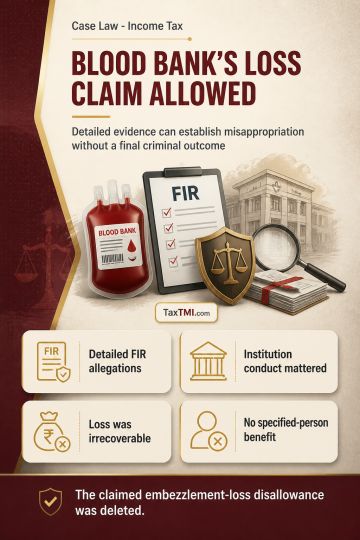
Embezzlement losses in charitable institutions remain allowable when misappropriation is established, irrecoverable, and not a specified-person benefi...
National long-distance undertaking status supports deduction where separately licensed infrastructure, resources, revenue, and expenditure establish c...
Agency reimbursement income follows contractual deposit-liability computation, while pending deposit collections do not constitute deemed-dividend loa...
Membership-consent thresholds for oppression petitions are satisfied by unchallenged voter-list consents, while unsupported forgery claims require pro...
HC held that the CIT(A)'s order directing deletion of additions relating to unexplained sundry creditors was valid. The AO's amendment under Section 154 was procedurally flawed as no notice was issued to the assessee, violating statutory requirements of Section 154(3). The court found a clear violation of natural justice principles by not providing an opportunity of hearing. Consequently, the order dated February 7, 2025 was set aside, and the authorities were directed to implement the previous order dated January 3, 2024 within four weeks, effectively reinstating the original appellate order deleting the contested additions.
HC held that the CIT(A)'s order directing deletion of additions relating to unexplained sundry creditors was valid. The AO's amendment under Section 154 was procedurally flawed as no notice was issued to the assessee, violating statutory requirements of Section 154(3). The court found a clear violation of natural justice principles by not providing an opportunity of hearing. Consequently, the order dated February 7, 2025 was set aside, and the authorities were directed to implement the previous order dated January 3, 2024 within four weeks, effectively reinstating the original appellate order deleting the contested additions.
Note: It is a system-generated summary and is for quick reference only.
 TaxTMI
  TaxTMI
 of 4881