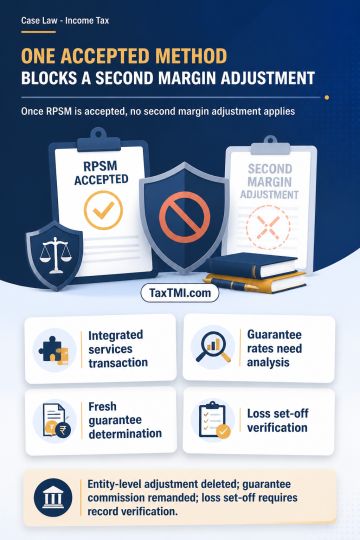
Form 26AS evidence requires successor-entity accounting verification after business transfer, while invoice-supported related-party advertising expend...
Money-laundering judgment timing requires awaiting the scheduled-offence decision despite continuation of the underlying trial where outcomes directly...
Accredited investor eligibility expands through securities-market exposure, while alternative investment fund disputes require prescribed resolution a...
Page of 4916
Press 'Enter' after typing page number.
41 to 60 of 98302 Results
❮
❯
❯❯
0 / 200
Expand Note
Add to Folder
No Folders have been created
+
Are you sure you want to delete "My most important" ?
ITAT held that once the Assessing Officer (AO) is satisfied with the reasons recorded for reopening the case and abstains from making additions on the specific grounds initially cited, the AO's jurisdiction terminates. The tribunal found that the AO cannot proceed to tax additional income that came to notice during reassessment proceedings beyond the original reasons for reopening the case. Relying on judicial precedent, the tribunal concluded that after explaining the initially suspected escaped income, the AO loses jurisdiction to make further additions. Consequently, the assessee's primary ground of challenge was allowed, effectively limiting the scope of reassessment to the originally identified potential tax discrepancy.
ITAT held that once the Assessing Officer (AO) is satisfied with the reasons recorded for reopening the case and abstains from making additions on the specific grounds initially cited, the AO's jurisdiction terminates. The tribunal found that the AO cannot proceed to tax additional income that came to notice during reassessment proceedings beyond the original reasons for reopening the case. Relying on judicial precedent, the tribunal concluded that after explaining the initially suspected escaped income, the AO loses jurisdiction to make further additions. Consequently, the assessee's primary ground of challenge was allowed, effectively limiting the scope of reassessment to the originally identified potential tax discrepancy.
Note: It is a system-generated summary and is for quick reference only.
 TaxTMI
 TaxTMI

 of 4916