Timely pronouncement of reserved judgments requires defined timelines, transparency measures, and remedial pathways to protect liberty and effective j...
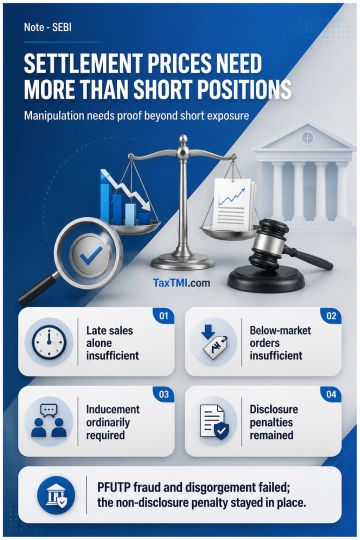
Settlement-price depression requires proof of manipulation, not merely short exposure, late selling, or below-market orders, preserving disclosure pen...
HC dismissed writ petition challenging a demand order under CGST Act. While the petition was technically maintainable under Article 226, the Court declined to entertain it due to the availability of an alternative statutory remedy under Section 107 of the CGST Act. The Court emphasized the established principle that when a specific statutory forum exists for grievance redressal, judicial discretionary intervention should be limited. The petitioner was directed to pursue the prescribed appellate mechanism, thereby preserving the statutory dispute resolution framework.
HC dismissed writ petition challenging a demand order under CGST Act. While the petition was technically maintainable under Article 226, the Court declined to entertain it due to the availability of an alternative statutory remedy under Section 107 of the CGST Act. The Court emphasized the established principle that when a specific statutory forum exists for grievance redressal, judicial discretionary intervention should be limited. The petitioner was directed to pursue the prescribed appellate mechanism, thereby preserving the statutory dispute resolution framework.
Note: It is a system-generated summary and is for quick reference only.
 TaxTMI
  TaxTMI
 of 4897