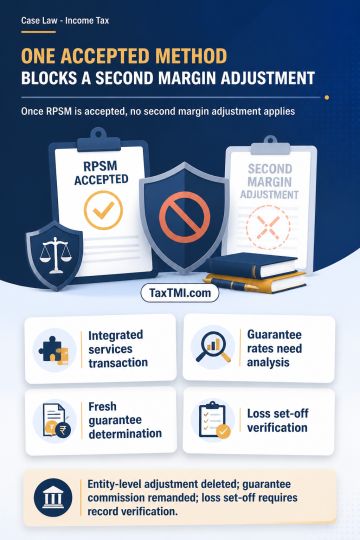
Form 26AS evidence requires successor-entity accounting verification after business transfer, while invoice-supported related-party advertising expend...
Money-laundering judgment timing requires awaiting the scheduled-offence decision despite continuation of the underlying trial where outcomes directly...
Accredited investor eligibility expands through securities-market exposure, while alternative investment fund disputes require prescribed resolution a...
Page of 4916
Press 'Enter' after typing page number.
41 to 60 of 98302 Results
❮
❯
❯❯
0 / 200
Expand Note
Add to Folder
No Folders have been created
+
Are you sure you want to delete "My most important" ?
ITAT adjudicated a tax assessment case involving section 153A and 153D approval process. The tribunal critically examined the approval mechanism, emphasizing that administrative sanction must not be a mere formality but require substantive reasoning and genuine examination of record. The court found the specific approval lacking in judicial application of mind, demonstrating procedural deficiency. Critically, the approval was deemed mechanically granted without proper evaluation of underlying documentary evidence. Consequently, the tribunal declared the approval invalid, rendering the entire assessment order void ab initio. The assessee's appeal was allowed, effectively nullifying the proposed tax assessment based on procedural impropriety in the approval process.
ITAT adjudicated a tax assessment case involving section 153A and 153D approval process. The tribunal critically examined the approval mechanism, emphasizing that administrative sanction must not be a mere formality but require substantive reasoning and genuine examination of record. The court found the specific approval lacking in judicial application of mind, demonstrating procedural deficiency. Critically, the approval was deemed mechanically granted without proper evaluation of underlying documentary evidence. Consequently, the tribunal declared the approval invalid, rendering the entire assessment order void ab initio. The assessee's appeal was allowed, effectively nullifying the proposed tax assessment based on procedural impropriety in the approval process.
Note: It is a system-generated summary and is for quick reference only.
 TaxTMI
 TaxTMI

 of 4916