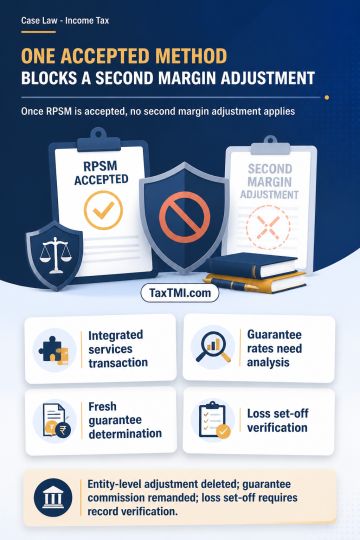
Form 26AS evidence requires successor-entity accounting verification after business transfer, while invoice-supported related-party advertising expend...
Money-laundering judgment timing requires awaiting the scheduled-offence decision despite continuation of the underlying trial where outcomes directly...
Accredited investor eligibility expands through securities-market exposure, while alternative investment fund disputes require prescribed resolution a...
Page of 4916
Press 'Enter' after typing page number.
41 to 60 of 98302 Results
❮
❯
❯❯
0 / 200
Expand Note
Add to Folder
No Folders have been created
+
Are you sure you want to delete "My most important" ?
The SC clarified that applications for fraudulent and wrongful trading under Section 66 of IBC are distinct from avoidance applications under Sections 43, 45, and 50. The Court upheld NCLT's approval of the Resolution Plan, ruling that NCLAT had improperly interfered with the Committee of Creditors' commercial wisdom regarding recoveries from fraudulent transactions. The Court emphasized that judicial review of resolution plans is limited to compliance with Section 30(2) requirements, with commercial decisions left to the CoC's discretion. The SC further determined that the resolution plan did not violate RBI or NHB Acts, as neither statute mandates full payment of deposits. The NCLT was directed to separately adjudicate avoidance applications and Section 66 applications.
The SC clarified that applications for fraudulent and wrongful trading under Section 66 of IBC are distinct from avoidance applications under Sections 43, 45, and 50. The Court upheld NCLT's approval of the Resolution Plan, ruling that NCLAT had improperly interfered with the Committee of Creditors' commercial wisdom regarding recoveries from fraudulent transactions. The Court emphasized that judicial review of resolution plans is limited to compliance with Section 30(2) requirements, with commercial decisions left to the CoC's discretion. The SC further determined that the resolution plan did not violate RBI or NHB Acts, as neither statute mandates full payment of deposits. The NCLT was directed to separately adjudicate avoidance applications and Section 66 applications.
Note: It is a system-generated summary and is for quick reference only.
 TaxTMI
 TaxTMI

 of 4916