Form 26AS evidence requires successor-entity accounting verification after business transfer, while invoice-supported related-party advertising expend...
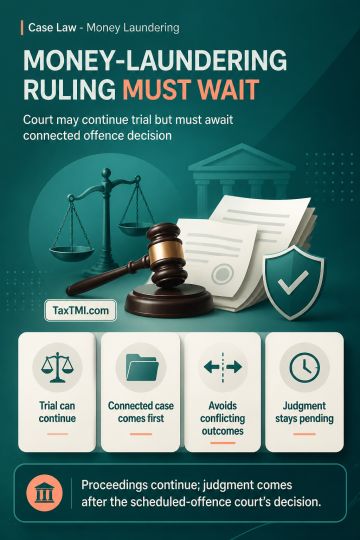
Money-laundering judgment timing requires awaiting the scheduled-offence decision despite continuation of the underlying trial where outcomes directly...
Accredited investor eligibility expands through securities-market exposure, while alternative investment fund disputes require prescribed resolution a...
Customs Assessment Portal centralises classification and valuation guidance to support consistent, transparent and informed compliance across stakehol...
Page of 4918
Press 'Enter' after typing page number.
101 to 120 of 98359 Results
❮
❯
❯❯
0 / 200
Expand Note
Add to Folder
No Folders have been created
+
Are you sure you want to delete "My most important" ?
HC ruled in favor of petitioner, ordering release of seized gold jewelry within 7 days. The court determined that Baggage Rules 2016 provision regarding items "carried on the person" was ultra vires to Section 79 of Customs Act 1962, as the Act only authorizes rules for articles in baggage, not worn items. The confiscation order was invalidated due to procedural defects: no show cause notice was issued, inadequate hearing opportunities were provided to the Sri Lankan petitioner, and the seizure was based on contradictory evidence regarding how the jewelry was carried. The court emphasized that jewelry worn by passengers falls outside Baggage Rules 2016 scope unless specifically concealed, requiring Section 101 Customs Act proceedings.
HC ruled in favor of petitioner, ordering release of seized gold jewelry within 7 days. The court determined that Baggage Rules 2016 provision regarding items "carried on the person" was ultra vires to Section 79 of Customs Act 1962, as the Act only authorizes rules for articles in baggage, not worn items. The confiscation order was invalidated due to procedural defects: no show cause notice was issued, inadequate hearing opportunities were provided to the Sri Lankan petitioner, and the seizure was based on contradictory evidence regarding how the jewelry was carried. The court emphasized that jewelry worn by passengers falls outside Baggage Rules 2016 scope unless specifically concealed, requiring Section 101 Customs Act proceedings.
Note: It is a system-generated summary and is for quick reference only.
 TaxTMI
  TaxTMI
 of 4918