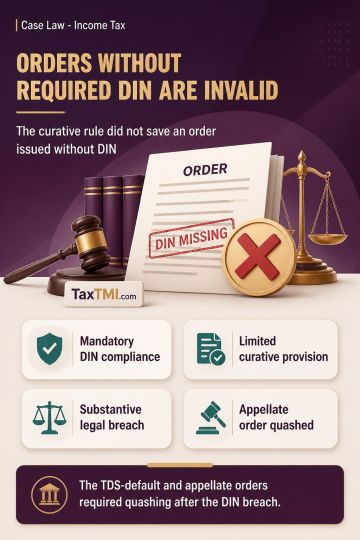
Document Identification Number compliance renders TDS-default orders invalid where mandatory DIN requirements are breached and curative provision does...
DGFT amended SION A-222 under FTP-2023 regarding export norms for Erythromycin Stearate tablets. The revised norm establishes that for manufacturing one tablet of Erythromycin Stearate (250 mg), the permitted import quantity of Erythromycin Stearate is 334 mg. The amendment, effective immediately, allows pro-rata calculations for other product variants. This modification, executed under paragraphs 1.03 and 2.04 of FTP-2023, standardizes the input-output ratio for pharmaceutical manufacturers engaged in export of Erythromycin formulations, ensuring regulatory compliance and manufacturing consistency.
DGFT amended SION A-222 under FTP-2023 regarding export norms for Erythromycin Stearate tablets. The revised norm establishes that for manufacturing one tablet of Erythromycin Stearate (250 mg), the permitted import quantity of Erythromycin Stearate is 334 mg. The amendment, effective immediately, allows pro-rata calculations for other product variants. This modification, executed under paragraphs 1.03 and 2.04 of FTP-2023, standardizes the input-output ratio for pharmaceutical manufacturers engaged in export of Erythromycin formulations, ensuring regulatory compliance and manufacturing consistency.
Note: It is a system-generated summary and is for quick reference only.
 TaxTMI
  TaxTMI
 of 4918