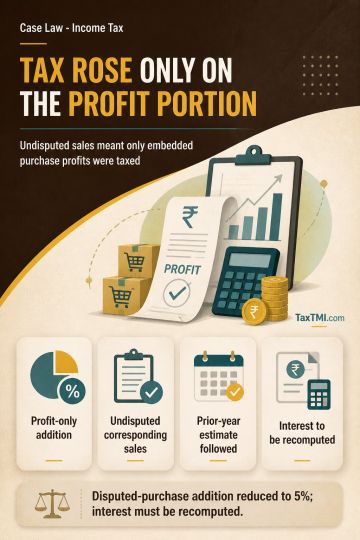
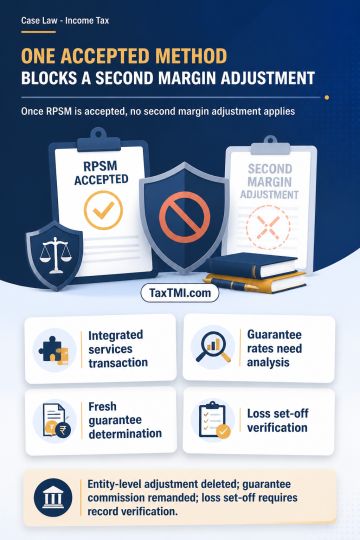
Form 26AS evidence requires successor-entity accounting verification after business transfer, while invoice-supported related-party advertising expend...
Money-laundering judgment timing requires awaiting the scheduled-offence decision despite continuation of the underlying trial where outcomes directly...
Accredited investor eligibility expands through securities-market exposure, while alternative investment fund disputes require prescribed resolution a...
Page of 4916
Press 'Enter' after typing page number.
41 to 60 of 98302 Results
❮
❯
❯❯
0 / 200
Expand Note
Add to Folder
No Folders have been created
+
Are you sure you want to delete "My most important" ?
The ITAT ruled in favor of the assessee trust operating a hospital, holding that income from its pharmacy operations qualifies for exemption under Section 11. The Tribunal determined that selling medicines, though on commercial basis, was incidental to the trust's charitable purpose of providing medical relief. Additional revenue streams including interest from fixed deposits, PCO receipts, canteen operations, nursing course fees, and rental income from premises were deemed incidental to the trust's dominant charitable purpose. The ITAT emphasized that these activities did not require separate accounting under Section 11(4A) as they were integral to achieving the main objective of providing educational/medical relief. The ruling established that incidental profit generation does not negate charitable status when the predominant purpose remains charitable in nature.
The ITAT ruled in favor of the assessee trust operating a hospital, holding that income from its pharmacy operations qualifies for exemption under Section 11. The Tribunal determined that selling medicines, though on commercial basis, was incidental to the trust's charitable purpose of providing medical relief. Additional revenue streams including interest from fixed deposits, PCO receipts, canteen operations, nursing course fees, and rental income from premises were deemed incidental to the trust's dominant charitable purpose. The ITAT emphasized that these activities did not require separate accounting under Section 11(4A) as they were integral to achieving the main objective of providing educational/medical relief. The ruling established that incidental profit generation does not negate charitable status when the predominant purpose remains charitable in nature.
Note: It is a system-generated summary and is for quick reference only.
 TaxTMI
 TaxTMI

 of 4916