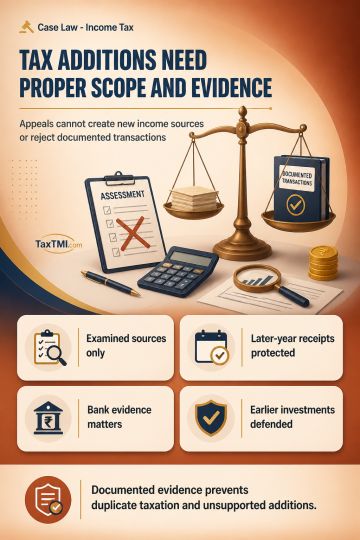
Appellate enhancement limits protect against new income sources, while documented credits and prior-year investments resist unexplained-income additio...
The CIT(A) has wide powers akin to reassessment. Once an assessment order is before CIT(A), its powers are not restricted to examining only grievances raised by the assessee but extend to the entire assessment to correct the AO. Under sec 250(4), CIT(A) can make further enquiries, fresh assessments and determine tax payability. Even if AO concluded income is non-taxable, CIT(A) can take a different view and bring that income to tax. Relying on Supreme Court decisions, ITAT held that the appellate authority has all original authority's powers, subject to statutory restrictions. Allowing the appeal for statistical purposes, ITAT emphasised the need for thorough and compliant adjudication.
The CIT(A) has wide powers akin to reassessment. Once an assessment order is before CIT(A), its powers are not restricted to examining only grievances raised by the assessee but extend to the entire assessment to correct the AO. Under sec 250(4), CIT(A) can make further enquiries, fresh assessments and determine tax payability. Even if AO concluded income is non-taxable, CIT(A) can take a different view and bring that income to tax. Relying on Supreme Court decisions, ITAT held that the appellate authority has all original authority's powers, subject to statutory restrictions. Allowing the appeal for statistical purposes, ITAT emphasised the need for thorough and compliant adjudication.
Note: It is a system-generated summary and is for quick reference only.
 TaxTMI
  TaxTMI
 of 4888