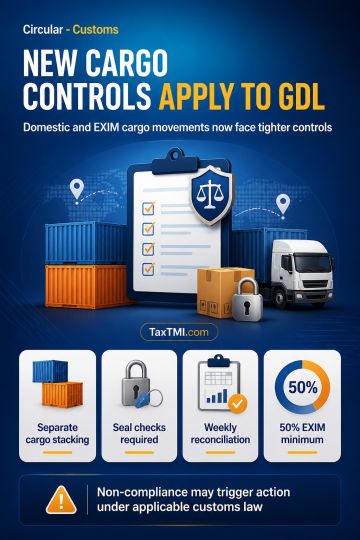
Customs-controlled cargo movement now includes GDL, subject to EXIM prioritisation, segregation, verification, reconciliation and enforcement safeguar...
The High Court held that the order passed by NCLT approving the Resolution Plan u/s 31(1) of the Insolvency and Bankruptcy Code, 2016 is an appealable order u/s 61, with a limitation period of 30 days + 15 days to file an appeal before NCLAT. As the respondents failed to challenge the NCLT order within the prescribed time, they cannot take a stand contrary to the approved Resolution Plan. Consequently, the writ petition was allowed.
The High Court held that the order passed by NCLT approving the Resolution Plan u/s 31(1) of the Insolvency and Bankruptcy Code, 2016 is an appealable order u/s 61, with a limitation period of 30 days + 15 days to file an appeal before NCLAT. As the respondents failed to challenge the NCLT order within the prescribed time, they cannot take a stand contrary to the approved Resolution Plan. Consequently, the writ petition was allowed.
Note: It is a system-generated summary and is for quick reference only.
 TaxTMI
  TaxTMI
 of 4881