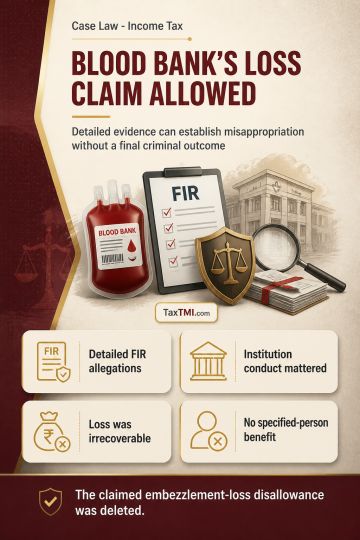
Embezzlement losses in charitable institutions remain allowable when misappropriation is established, irrecoverable, and not a specified-person benefi...
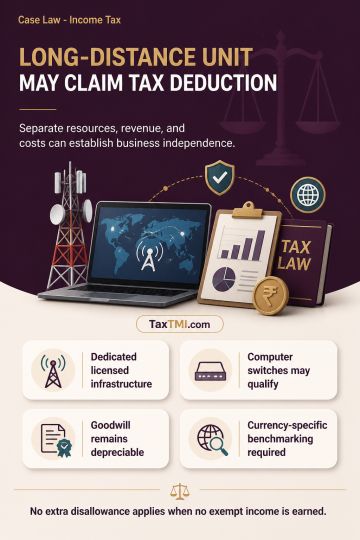
National long-distance undertaking status supports deduction where separately licensed infrastructure, resources, revenue, and expenditure establish c...
Agency reimbursement income follows contractual deposit-liability computation, while pending deposit collections do not constitute deemed-dividend loa...
Membership-consent thresholds for oppression petitions are satisfied by unchallenged voter-list consents, while unsupported forgery claims require pro...
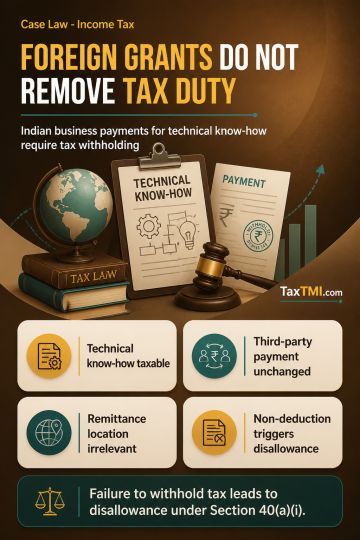
The High Court dismissed the appeals filed by the Revenue as withdrawn, holding that the appeals did not fall under the exception carved out in Circular No. 3.1(l) dated 15.03.2024. The Court ruled that the exception in Clause 3.1(l) applies only to cases where the deductor failed to deduct tax at source and the tax was sought to be recovered from the payer. However, in the present case, the issue pertained to the disallowance of expenses claimed by the assessee due to non-deduction of tax at source u/s 195. The Court clarified that litigation arising from regular assessments u/s 143(3) and failure to deduct tax at source are treated separately under the Act. Consequently, the enhanced monetary limits specified in the Circular applied retrospectively, rendering the tax effect in the appeals below the prescribed threshold, leading to their dismissal.
The High Court dismissed the appeals filed by the Revenue as withdrawn, holding that the appeals did not fall under the exception carved out in Circular No. 3.1(l) dated 15.03.2024. The Court ruled that the exception in Clause 3.1(l) applies only to cases where the deductor failed to deduct tax at source and the tax was sought to be recovered from the payer. However, in the present case, the issue pertained to the disallowance of expenses claimed by the assessee due to non-deduction of tax at source u/s 195. The Court clarified that litigation arising from regular assessments u/s 143(3) and failure to deduct tax at source are treated separately under the Act. Consequently, the enhanced monetary limits specified in the Circular applied retrospectively, rendering the tax effect in the appeals below the prescribed threshold, leading to their dismissal.
Note: It is a system-generated summary and is for quick reference only.
 TaxTMI
  TaxTMI
 of 4881