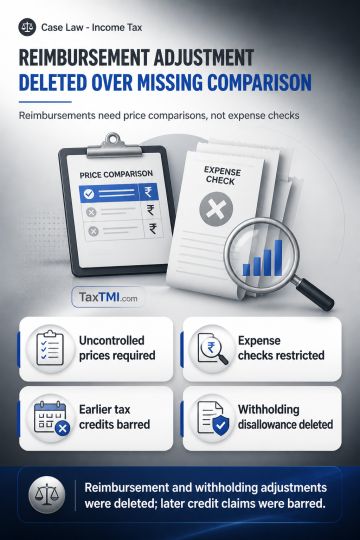
Transfer-pricing reimbursement adjustments require uncontrolled comparables and cannot become expense-genuineness reviews, resulting in deletion of th...
Food import sampling requirements support provisional release where unseized consignments conform to standards and raw areca classification is unestab...
Diagnostic microcuvette classification follows sole-use analytical function, placing specialised disposable cuvettes with their analyser rather than g...
Customs Broker licensing proceedings fail when their offence-report foundation collapses and authorisation, advisory, and KYC duties remain unbreached...
Page of 4891
Press 'Enter' after typing page number.
501 to 520 of 97820 Results
❮
❯
❯❯
0 / 200
Expand Note
Add to Folder
No Folders have been created
+
Are you sure you want to delete "My most important" ?
The NCLAT dismissed the appeal challenging the approval of the resolution plan by the Committee of Creditors (CoC) and the Adjudicating Authority. The key findings were: The adoption of the Swiss Challenge Method by the CoC for value maximization was an outcome of its commercial wisdom, which cannot be interfered with. The appellant's contention questioning the Swiss Challenge method lacked merit. The Resolution Professional (RP) conducted the Corporate Insolvency Resolution Process (CIRP) fairly and transparently, providing equal opportunity to all resolution applicants. The CoC duly considered and evaluated the revised resolution plan of the successful resolution applicant (SRA) before approval. The appellant's claim of denial of effective participation in CoC meetings was unfounded. The Adjudicating Authority did not err in approving the SRA's resolution plan, as no grounds u/s 61(3) of the Insolvency and Bankruptcy Code (IBC) were established to interfere with the CoC's commercial decision. The NCLAT upheld the primacy of the CoC's commercial wisdom and found no irregularities in the CIRP conduct by the RP.
The NCLAT dismissed the appeal challenging the approval of the resolution plan by the Committee of Creditors (CoC) and the Adjudicating Authority. The key findings were: The adoption of the Swiss Challenge Method by the CoC for value maximization was an outcome of its commercial wisdom, which cannot be interfered with. The appellant's contention questioning the Swiss Challenge method lacked merit. The Resolution Professional (RP) conducted the Corporate Insolvency Resolution Process (CIRP) fairly and transparently, providing equal opportunity to all resolution applicants. The CoC duly considered and evaluated the revised resolution plan of the successful resolution applicant (SRA) before approval. The appellant's claim of denial of effective participation in CoC meetings was unfounded. The Adjudicating Authority did not err in approving the SRA's resolution plan, as no grounds u/s 61(3) of the Insolvency and Bankruptcy Code (IBC) were established to interfere with the CoC's commercial decision. The NCLAT upheld the primacy of the CoC's commercial wisdom and found no irregularities in the CIRP conduct by the RP.
Note: It is a system-generated summary and is for quick reference only.
 TaxTMI
  TaxTMI
 of 4891