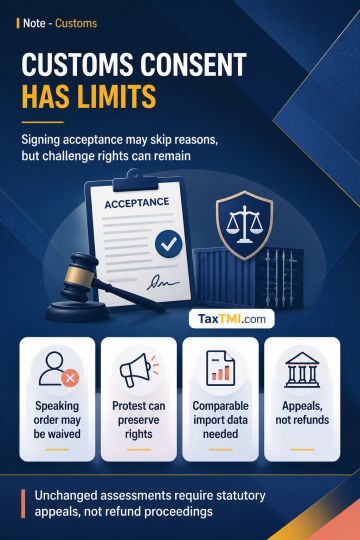
Customs transaction value rejection requires communicated reasonable doubt, while written reassessment acceptance preserves challenges to enhanced val...
Challenge-mechanism compliance clarifications permitted, while unilateral revised resolution plans may be refused under creditors' commercial discreti...
The High Court quashed the show cause notices (SCNs) and any final orders passed in the pending adjudication proceedings initiated under the Customs Act, 1962, Finance Act, 1994. The court held that the inordinate delay by the respondents in concluding the adjudication proceedings for decades constituted a sufficient ground to annul those proceedings. Despite legislative provisions enabling the proper officers to seek extensions and conclude pending proceedings, the respondents failed to take proactive and effective steps to conclude proceedings initiated as far back as 2006. The court emphasized that matters involving financial liabilities or penal consequences cannot be kept pending for years, and the flexibility provided by the statute cannot be construed as sanctioning lethargy or indolence. The respondents were obligated to prove that it was impracticable to proceed or they were constrained by factors beyond their control. The practice of mechanically placing matters in the call book and retrieving them without proper application of mind was not acceptable.
The High Court quashed the show cause notices (SCNs) and any final orders passed in the pending adjudication proceedings initiated under the Customs Act, 1962, Finance Act, 1994. The court held that the inordinate delay by the respondents in concluding the adjudication proceedings for decades constituted a sufficient ground to annul those proceedings. Despite legislative provisions enabling the proper officers to seek extensions and conclude pending proceedings, the respondents failed to take proactive and effective steps to conclude proceedings initiated as far back as 2006. The court emphasized that matters involving financial liabilities or penal consequences cannot be kept pending for years, and the flexibility provided by the statute cannot be construed as sanctioning lethargy or indolence. The respondents were obligated to prove that it was impracticable to proceed or they were constrained by factors beyond their control. The practice of mechanically placing matters in the call book and retrieving them without proper application of mind was not acceptable.
Note: It is a system-generated summary and is for quick reference only.
 TaxTMI
  TaxTMI
 of 4927