Customs-controlled cargo movement now includes GDL, subject to EXIM prioritisation, segregation, verification, reconciliation and enforcement safeguar...
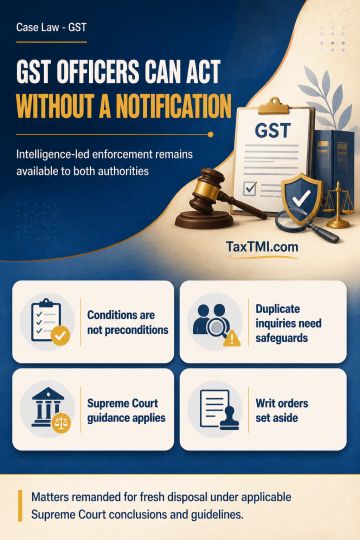
GST cross-empowerment remains effective without conditional notification, while duplicate proceedings require established safeguards against overlappi...
The Tribunal upheld the penalty imposed u/ss 271(1)(c) and 271AAB of the Income Tax Act for additional income brought to tax owing to a search and seizure action. The Tribunal observed that the income was assessed based on material seized during the search, supported by a declaration u/s 131. The assessee's contention of voluntary surrender was rejected, as the additional income came to light solely due to the search action. The Tribunal relied on Supreme Court precedents, including MAK Data Pvt Ltd and K P Madhusudan, which established that penalty is leviable when income is finally assessed higher than the returned income, irrespective of whether the variation arose from voluntary surrender or otherwise. Accordingly, the Tribunal set aside the CIT(A)'s orders for the relevant assessment years and restored the penalty orders.
The Tribunal upheld the penalty imposed u/ss 271(1)(c) and 271AAB of the Income Tax Act for additional income brought to tax owing to a search and seizure action. The Tribunal observed that the income was assessed based on material seized during the search, supported by a declaration u/s 131. The assessee's contention of voluntary surrender was rejected, as the additional income came to light solely due to the search action. The Tribunal relied on Supreme Court precedents, including MAK Data Pvt Ltd and K P Madhusudan, which established that penalty is leviable when income is finally assessed higher than the returned income, irrespective of whether the variation arose from voluntary surrender or otherwise. Accordingly, the Tribunal set aside the CIT(A)'s orders for the relevant assessment years and restored the penalty orders.
Note: It is a system-generated summary and is for quick reference only.
 TaxTMI
  TaxTMI
 of 4879