Capital-gains exemption for charitable trusts extends to qualifying fixed deposits, while unrecoverable TDS write-offs may constitute income applicati...
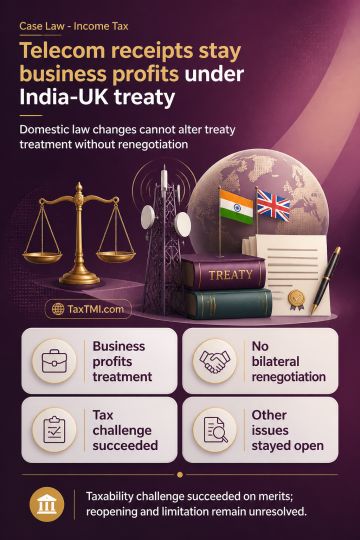
India-UK treaty characterisation of telecom-service receipts as business profits withstands unilateral domestic-law amendments for Indian tax purposes...
Page of 4897
Press 'Enter' after typing page number.
581 to 600 of 97923 Results
❮
❯
❯❯
0 / 200
Expand Note
Add to Folder
No Folders have been created
+
Are you sure you want to delete "My most important" ?
The Appellate Tribunal held that the Assessing Officer (AO) did not satisfy the condition precedent before issuing a notice u/s 153C of the Income Tax Act against the appellant, who was a third party not subjected to search. The satisfaction note prepared by the AO did not meet the legal requirements as the seized material did not pertain to or contain anything incriminating against the appellant. Consequently, the assumption of jurisdiction u/s 153C for the assessment years 2014-15 and 2016-17 was held to be bad in law, rendering the consequent assessment orders null and void. Regarding additions made in the unabated assessment years, the Tribunal relied on Supreme Court decisions to hold that in unabated assessments u/s 153C, additions are permissible only if based on incriminating material found during the search. Since no such material existed against the appellant, the additions made u/s 56(2)(vii)(b) were directed to be deleted for the assessment years 2014-15 and 2016-17.
The Appellate Tribunal held that the Assessing Officer (AO) did not satisfy the condition precedent before issuing a notice u/s 153C of the Income Tax Act against the appellant, who was a third party not subjected to search. The satisfaction note prepared by the AO did not meet the legal requirements as the seized material did not pertain to or contain anything incriminating against the appellant. Consequently, the assumption of jurisdiction u/s 153C for the assessment years 2014-15 and 2016-17 was held to be bad in law, rendering the consequent assessment orders null and void. Regarding additions made in the unabated assessment years, the Tribunal relied on Supreme Court decisions to hold that in unabated assessments u/s 153C, additions are permissible only if based on incriminating material found during the search. Since no such material existed against the appellant, the additions made u/s 56(2)(vii)(b) were directed to be deleted for the assessment years 2014-15 and 2016-17.
Note: It is a system-generated summary and is for quick reference only.
 TaxTMI
  TaxTMI
 of 4897